Showing posts with label Poetry. Show all posts

01 September 2026

Looking at September

    from  THE GARDEN IN SEPTEMBER

Now thin mists temper the slow ripening beams
Of the September sun: his golden gleams
On gaudy flowers shine,that prank the rows
Of high-grown hollyhocks, and all tall shows
That Autumn flaunteth in his bushy bowers;
Where tomtits, hanging from the drooping heads
Of giant sunflowers, peck the nutty seeds;
And in the feathery aster bees on wing
Seize and set free the honied flowers,
Till thousand stars leap with their visiting:
While ever across the path mazily flit,
Unpiloted in the sun,
The dreamy butterflies
With dazzling colours powdered and soft glooms,
White black and crimson stripes, and peacock eyes,
Or on chance flowers sit,
With idle effort plundering one by one
The nectaries of deepest-throated blooms

                                                   Robert Bridges (1844 - 1930)

The 1st of the month marks the start of meteorological autumn, astronomically Autumn doesn't begin until Mabon or the  Autumn Equinox which is on the 23rd this year.


Fair on the first of September, fair for the whole month


The Anglo-Saxons called September Gertsmonarth, meaning the Barley Month


There are generally three consecutive windy days around the middle of the month, millers called these the windy days of barley harvest.


In this year of excess heat the wheat and barley harvest is long finished. There isn't any sugar beet growing close by this year but farmers who have grown it will be looking at a very small crop later. Maybe sugar will be yet another thing that will see a price rise in winter as well as flour and dairy products - all due to the heat and lack of rain.


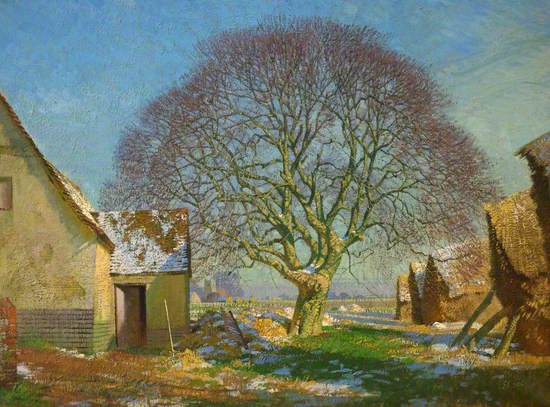


Young September's Cornfield 1954
Oil on board
Alan Reynolds (1926-2014)


16 April 2026

Who Knew?

 Who knew there's a poem for all of us who have birthdays this month?


APRIL BIRTHDAY

When your birthday brings the world under your window
And the song-thrush sings wet-throated in the dew
And aconite and primrose are unsticking the wrappers
Of the package that has come today for you
Lambs bounce out and stand astonished
Puss willow pushes among the bare branches
Sooty hawthorns shiver into emerald

And a new air
Nuzzles the sugary
Buds of the chestnut. A groundswell and a stir
Billows the silvered 
Violet silks
Of the south  - a tenderness
Lifting through all the
Gently-breasted
Counties of England

When the swallow snips the string that holds the world in
And the ring-dove claps and nearly loops the loop
You just can't count everything that follows in the tumble
Like a whole circus tumbling through a hoop

Grass in a mesh of all flowers floundering
Sizzling leaves and blossoms bombing
Nestling hissing and groggy-legged insects

And the trees
Stagger, they stronger
Brace their boles and biceps under
The load of gift. And the hills float
Light as a bubble glass
On the smoke blue evening
And rabbits are bobbing everywhere, and a thrush
Rings coolly in a far corner. A shiver of green
Strokes the darkening slope as the land
Begins her labour.

TED HUGHES (1930 - 1998)


09 February 2026

Snowdrops ....or to give them their Latin name..... Galanthus.

Unfortunately the snowdrops in this picture aren't in my garden. It's four years since blog reader Jan brought me a bag of snowdrops 'in the green' . I planted them in various places in the back and front gardens but  like everything else planted here (except trees) they mostly vanished. A few re-appeared in 2023 but since then only one small clump .  The back garden gets no sun in winter and can be a frost pocket when the weather is bad and the soil is poor anyway. No point planting more.

These snowdrops that I photographed last week are across the road on the bank of the churchyard, right by the road. They have spread really well recently coming up despite being among grass, with water splash from traffic. The bank faces south-west so is in the sun for hours which must make all the difference.


The word Galanthus comes from from the Greek words gala (milk) and anthos (flower). Originally a native of alpine areas of Europe and Asia, it was considered to be a holy plant, a symbol of purity, chastity and hope and was dedicated to the Virgin Mary. According to my little book of plant folklore Snowdrops should only be brought into the house with a 'white purification' ceremony  and it was considered unlucky to bring them into the house at all before Candlemas. They were often called Candlemas bells.

Many poets have written poetry about these small flowers

Brother, Joy to you
I've brought some snowdrops; only just a few,
But quite enough to prove the world awake,
Cheerful and hopeful in the frosty dew
And for the pale sun's sake.

Christina Rosetti

SNOWDROPS
I like to think 
That, long ago
There fell to earth
Some flakes of snow
Which loved this cold,
Grey world of ours
So much, they stayed 
As snowdrop flower

 Mary Vivian


Many, many welcomes,
February fair-maid,
Ever as old time,
Solitarty firstling,
Coming in the cold time,
Prophet of the gay time,
Prophet of the May time
Prophet of the roses,
Many, many welcomes,
February fair-maid.

Alfred Lord Tennyson

*******************

My plans for no shopping this week went haywire as Son said he'd bring a chicken over on Sunday and cook a roast dinner for us all.  I provided some of the other bits so I've used up all the carrots that were in the fridge and used most of the eggs to make Yorkshire puddings.. I had half a packet of stuffing mix left from the nut roast made before Christmas which was handy and an ice cream dessert in the freezer also from Christmas - so that's been used too.
 I don't like a fridge with no eggs and no carrots - one of my basic veg to have on hand so will have to shop after all.

Main meals this week will be............
Portion of nut roast from freezer with roast potatoes left from Sunday and veg and gravy.
Leek fritters with bacon
Baked fish in batter with sweet potato chips and peas
Portion Quorn Bolognese sauce from freezer over spaghetti 

and other things that I've not thought of yet......I'm not much good at meal planning now it's just me!

21 January 2026

January

   A January Painting

Morning in January


                                                                      Morning in January 1956

              Gerald Gardiner (1902 -1959)

A January Poem


Cold is the winter day, misty and dark:
The sunless sky with faded gleams is rent:
And patches of thin snow outlying, mark
The landscape with a drear disfigurement.

The trees their mournful branches lift aloft:
The oak with knotty twigs is full of trust,
With bud-thronged bough the cherry in the croft;
The chestnut holds her gluey knops upthrust.

No birds sing, but the starling chaps his bill
And chatters mockingly; the new-born lambs
Within their straw-built fold beneath the hill
Answer with plaintive cry their bleating lambs.

Their voices melt in welcome dreams of spring,
Green grass and leafy trees and sunny skies:
My fancy decks the woods, the thrushes sing,
Meadows are gay, bees hum and scents arise.

And God the Maker doth my heart grow bold
To praise wintry works not understood,
Who all the worlds and ages doth behold,
Evil and good as one, and all is good


January by Robert Bridges(1844 - 1930)


Can you guess I'm short of things to write about?! 

24 December 2025

Christmas Eve

The Oxen

Christmas Eve, and twelve of the clock.
'Now they are all on their knees,'
An elder said as we sat in a flock
By the embers in hearthside ease.

We pictured the meek mild creatures where
They dwelt in their strawy pen,
Nor did it occur to one of us there
To doubt they were kneeling then.

So fair a fancy few would weave
In these years! Yet I feel
If someone said on Christmas Eve, 
Come see the oxen kneel

'In the lonely barton by yonder coomb
Our childhood used to know,'
I should go with him in the gloom,
Hoping it might be so.

Thomas Hardy


Every year these appear on the green near the village hall  where we do our Keep Moving Group - and each year there are more.


Why did Father Christmas need so many umbrellas?

It was because of the rein deer!


Michael Bublé reads The Visit from St Nicholas - now often known as The Night Before Christmas


Yesterday the coffee in the advent  calendar was the Cinnamon - I gave it a sniff and decided not to try it - cinnamon is not one of my favourite spices. And I forgot to say there was an empty section one day last week which was why there were two sachets in one section the week before.

Had visitors all at once yesterday morning as I was cooking the ham and about to make cheese straws for EGS. Because he was so poorly as a baby before the first operation and then again later before his second he had several years when he was never hungry - so odd for a growing boy - but could always manage the cheese straws at Nanna's. Now I make some for each time they are in Suffolk. 

Sister in Law was here as I was putting the honey and mustard on the fat edge of  ham before finishing it off in the oven - she said she'd never seen that before - but it's what I've done for ever and I said my cheese straw recipe involves adding grated cheese to the rolled out dough, folding over and repeating before cutting and baking and she'd not heard of that before either. Funny how we all do different.

YD and EGD came over later on their way to staying with Eldest Daughter in the holiday cottage, it was a good thing I had the ham cooked so I had something to give them for lunch - this is why I have to have things in for all eventualities. All my children tend to organise themselves and their families and forget to tell me what they are doing!

01 October 2025

October Days

 OCTOBER

This may contain: a poem written in the style of autumn with leaves and flowers on it, surrounded by other words


I'm not sure where September went but it's gone.

 October was originally the eighth month of the Roman calendar. The Anglo Saxons called it Wynmonath - the wine making month or Winterfylleth meaning the the month with the full moon (7th) heralding winter. This year the October full moon will be a super moon and is also the latest date possible for a Harvest moon.

I've probably mentioned all the bits of weather folklore for October in previous years but here are three good ones. 

Dry your barley in October,
Or you'll always be sober.
(Malted barley is the main ingredient of beer, which was drunk by everyone when water wasn't safe)

A good October and a good blast,
To blow the hog acorn and mast.
(Dating from the time when villagers were allowed to turn their pigs into the woods to feed on acorns and Beech mast - called pannage

In October manure your field
And your land it's wealth  shall yield
(Best time for muck spreading, before the fields get too wet,  ready to sow crops in the spring)

A page from the Brambly Hedge Autumn Story by Jill Barklem


A  poem from the book " A Child's Garden of Verses" by Robert Louis Stevenson 

AUTUMN FIRES

In the other gardens
And all up the vale
From the Autumn bonfires
See the smoke trail!
 
Pleasant summer over
And all the summer flowers,
The red fire blazes
The grey smoke towers
 
Sing a song of seasons
Something bright in all
Flowers in the summer
Fires in the fall.
 
 
I like the line "Sing a song of seasons" and as I get older it seems to be easier to appreciate each season as it arrives - after all if I'm still around to see a new season then that has to be a good thing!

And Thank you to everyone for comments yesterday about the unusual crop growing in the fields around here. The conclusion was reached that it's definitely Quinoa ........probably!

Back Soon

26 September 2025

Autumn Poetry and Painting

Firstly must say thank you to everyone for comments about village names yesterday and apologies for not replying and also for not commenting on any blogs. The day just went somewhere in a flash!

Had a blank for ideas for todays post so I cheated and looked back at some of the autumn poetry that's been on the blog...................

Autumn Leaves
ArtistJohn Everett Millais
Year1856


                                                                     Autumn Birds

The wild duck startles like a sudden thought,
And heron slow as if it might be caught.
the flopping crows on weary wings go by
And grey beard jackdaws noising as they fly.
The crowds of starnels whizz and hurry by,
And darken like a cloud the evening sky.
The larks like thunder rise and suthy round,
Then drop and nestle in the stubble ground.
The wild swan hurries high and noises loud
With white necks peering to the evening cloud
The weary rooks to distant woods are gone 
With length of tail the magpie winnows on
To neighbouring tree and leaves the distant crow
While small birds nestle in the hedge below

John Clare (1793-1864)


The Golden Rod is yellow
The Corn is turning brown
The trees in apple orchards
With fruit are bending down
The gentian's bluest fringes
Are curling in the sun
In dusty pods the milkweed
It's hidden silk has spun
The sedges flaunt their harvest
In every meadow nook
And asters by the brook-side
Make asters in the brook
From dewy lanes at morning
The grapes sweet odours rise
At noon the roads all flutter 
With yellow butterflies
By all these lovely tokens
September days are here
With summer's best of weather
And autumns best of cheer
But none of all this beauty
Which floods the earth and air
Is unto me the secret
Which makes September fair.
T'is a thing which I remember
To name it thrills me yet
One day of one September
I never can forget.

Helen Hunt Jackson (1830-1885)


The verse of a poem by Alex Smith ,that's in the Diary of an Edwardian Country Lady book, possibly a Victorian Scottish poet.

Best I love September's yellow,
Morns of dew-strung gossamer,
Thoughtful days without a stir,
Rooky clamours, brazen leaves,
Stubble dotted o'er with sheaves-
More than Spring's bright uncontrol
Suit the Autumn of my soul


 SEPTEMBER

Now everyday the bracken browner grows,
Even the purple stars
Of clematis,that shone about the bars,
Grow browner; and the little autumn rose
Dons, for her rosy gown,
Sad weeds of brown.
 
Now falls the eve; and ere the morning sun,
Many a flower her sweet life will have lost,
Slain by the bitter frost,
Who slays the butterflies also, one by one,
The tiny beasts
That go about their business and their feasts.

                         Mary Coleridge ( 1861-1907)


SEPTEMBER
Golden in the garden,
Golden in the glen,
Golden, golden, golden
September's here again!
Golden in the tree tops,
Golden in the sky—
Golden, golden, golden
September's going by!
                                                         
                                                                   Annette Wynne (writing between 1919 and 1922)


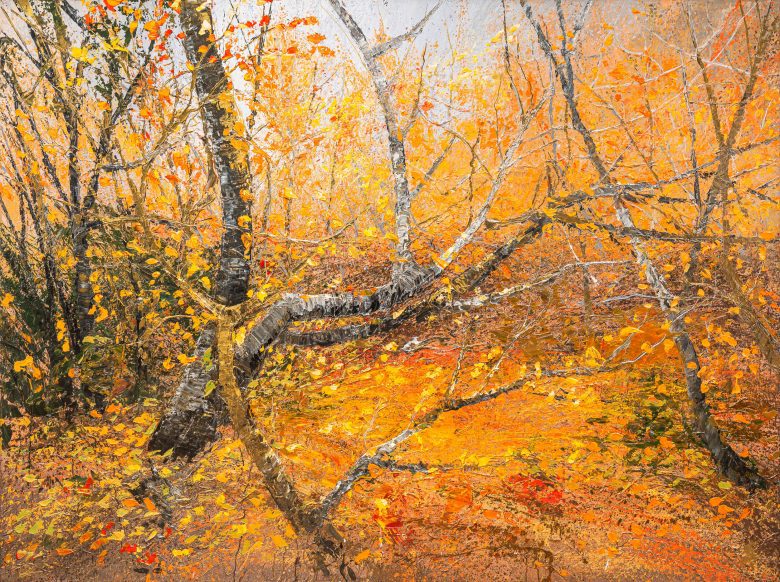
Autumn Leaves by Paul Kenton
autumn-leaves-original—landscape-painting-paul-kenton


02 June 2025

June Country Days on the 2nd of the Month

June - my favourite month of the year, meteorologically the start of summer (or  wait to the 21st for the astronomical start)

It is thought that June is named after the goddess Juno or possibly from Iuniores which was the lower level of the legislature in the constitution of ancient Rome.

Calm weather in June, sets the farmer in tune

 The weather pattern for June often alternates between spells of stormy weather and shorter periods of dry calm. The farmers prefer calm and warm with night-time dew to speed up crop growth and statistically June is England's sunniest month.


Summer Moon Walk . An Illustration by Angela Harding from her  book 'A Year Unfolding'

Other people in the past have also enjoyed June and written poems


Christina Rossetti said in her poem                    Summer

If the year would stand
Still at June for ever,
With no further growth on land
Nor further flow of river.
If all nights were shortest nights
And longest days were all seven,
This might be a merrier world
To my mind to live in.


JUNE 

Mine is the Month of Roses; yes, and mine
  The Month of Marriages!  All pleasant sights
And scents, the fragrance of the blossoming vine,
  The foliage of the valleys and the heights.
Mine are the longest days, the loveliest nights;
  The mower's scythe makes music to my ear;
I am the mother of all dear delights;
  I am the fairest daughter of the year.

From 'The Poets Calendar' By Longfellow 

And another written for children by Irene F Pawsey

Month of leaves,
Month of roses;
Gardens full
Of dainty posies;
Skies of blue,
Hedgerows gay,
Meadows sweet
With the new mown hay.

Flowery banks,
A-drone with bees,
Dreaming cattle
Under trees:
Song-birds pipe
A merry tune—
This is summer,
This is June.

And way, way back in 1557 Thomas Tusser said in his Five hundred points of good husbandry


In June get thy wedehoke, they knife and thy glove,
And wede out such wede as the corn doth not love;
Slack no time weding, for darth nor for cheape;
Thy corn shall reward it, or ever thou reap.

I think this means - keep weeding that garden!

Back Soon
Sue

01 March 2025

March 1st

 In the Roman calendar March, or Martius, was the first month of the new year. The month was named after Mars, the god of war and the guardian of agriculture. March was the month when both farming and warfare could begin again after winter.


1st March, St David's Day, The Patron St of Wales. The start of meteorological spring.

Upon St David's Day
Put oats and barley in the clay

2nd March, St Chad's Day(Bishop of Northumbria in the 7th Century)

Saint's David and Chad
Sow peas, good or bad.


Stained Glass from Holy Cross Monastery New York


4th March, Shrove Tuesday - Pancakes!


5th March, St Pirans Day and Ash Wednesday

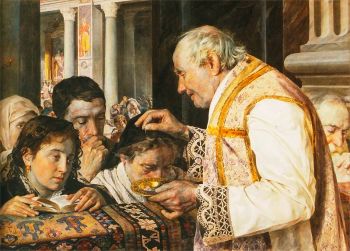
Ashes are sprinkled on the top of the head in this 1881 Polish painting.
Sprinkling of Ashes from a Polish Painting C19

6th March, World Book Day

14th March, Full Moon - The Lenten Moon or Plough Moon
 
17th March,  St Patrick's Day. Patron Saint of Ireland  and St Joseph of Arimathea.

If St Joseph's Day is clear
We shall have a fertile year.
 
20th March,  Vernal Equinox, the start of Astronomical spring and Ostara, The Pagan festival celebrating Eostre, Goddess of Spring. 

 21st  March, St Benedict's Day (also July 21st)

Whatever the weather on 21st, that weather will stay until 21st June
 
25th March, Lady Day. The feast of the Annunciation and 1st Quarter day

An east wind on Lady Day
Will keep on 'til the end of May

29th March, Super New Moon and Clocks go Forward Overnight
 
30th March, Mothering Sunday 


It is the first mild day of March:
Each minute sweeter than before,
The redbreast sings from the tall larch
That stands beside our door.

There is a blessing in the air,
Which seems a sense of joy to yield
To the bare trees, and mountains bare,
And grass in the green field.

From ' To My Sister' by William Wordsworth


Back Soon
Sue


01 February 2025

February Country Days


A February page from The Nature Notes of an Edwardian Lady by Edith Holden

The Anglo-Saxons called February 'Solmonarth' which means flat-cake month. Cakes would be made as offerings to the gods in thanks for the lengthening daylight.

The full moon this month, on the 12th, was known as the Ice Moon or the Snow Moon and snow and ice are  just as likely in February as they are in January.

I found this February poem by Jane G Austin. An American poet and author who lived between 1831-1894.

February

by Jane Goodwin Austin

I thought the world was cold in death;
The flowers, the birds, all life was gone,
For January's bitter breath
Had slain the bloom and hushed the song.

And still the earth is cold and white,
And mead and forest yet are bare;
But there's a something in the light
That says the germ of life is there.

Deep down within the frozen brook
I hear a murmur, faint and sweet,
And lo! the ice breaks as I look,
And living waters touch my feet.

Within the forest's leafless shade
I hear a spring-bird's hopeful lay:
O life to frozen death betrayed
Thy death shall end in life to-day.

And in my still heart's frozen cell
The pulses struggle to be free;
While sweet the bird sings, who can tell
But life may bloom again for thee!


I wrote about Imbolc, St Bridget's  Day and Candlemas last year so won't repeat again so soon but there are lots of weather sayings for February....................


When gnats dance in February, the husbandman becomes a beggar

A February spring is not worth a pin

Fogs in February mean frosts in May

                                                                 Double faced February

There is always one fine week in February 


Two weather sayings for tomorrow, February 2nd............. 

If Candlemas Day be mild and gay,
Go saddle your horses and buy them hay
But if Candlemas Day be stormy and black
It carries the winter on it's back 

 If Candlemas Day be fair and bright
Winter will take another flight
If Candlemas Day be cloud and rain
Winter is gone and will not come again.


Back Soon
Sue

02 January 2025

January Days and Thank You

 It was really good yesterday to have so many comments - I loved them all. Special thank you and "hello" to people who'd not commented before and apologies for not replying individually. My excuse was that I was out at Son and DiL's house with the two grandchildren plus YD and EGD who came over from the coast through the very wet and windy weather (luckily it had stopped raining and blowing by evening going home time) plus BiL came too, we were all there helping to eat up their Christmas food. They are never knowingly under-catered! Now they need more visitors to help eat yesterdays food!

It was a lovely surprise to switch on the lap top when I got in to find 60+ comments, cheered me up no end because coming home after family days is still tough, even if it is the 7th Christmas.
 
It's good to know from Debs that my punctuation is appreciated as I'm not always sure I have apostrophes in the right place! and I know I use far too many exclamation marks!!

So,  here we go into January..................


The January page from 'An Illustrated Country Year' by Celia Lewis


The Anglo Saxons used the name Wulfmonath for January, the month when wolves would be hunting for food. Difficult to imagine that wolves roamed the woods and forests of England, Scotland and Wales back in the 6th Century and it must be the reason the full moon this month was called the Wolf Moon. This year it's on the 13th and was also known as the Moon After Yule and, according to my new book  - Everyday Folklore by Liza Frank, it's also known as the Stay At Home Moon - which, considering tomorrows post is called  'Just Stay In January', is very apt! (Although they may well have made up that moon name, as I've never come across it anywhere else).


January is usually colder than December and this is one of the best known sayings..............


As the day lengthens, so the cold strengthens

Other sayings for the month include.............


When oak trees bend with snow in January, good crops may be expected.

In January much rain and little snow is bad for mountains, valleys and trees


Mild weather isn't recommended, so it's probably good that the weather forecast is for a spell of colder weather over the next few days. 

 A January spring is good for nothing

January warm, the Lord have mercy

Us gardeners always want good frosts in winter to kill off all the nasties that lurk in the soil. Most years recently our winters just haven't been cold enough.


JANUARY 

Janus am I; oldest of potentates;
  Forward I look, and backward, and below
I count, as god of avenues and gates,
  The years that through my portals come and go.

I block the roads, and drift the fields with snow;
  I chase the wild-fowl from the frozen fen;
My frosts congeal the rivers in their flow,
  My fires light up the hearths and hearts of men.


Longfellow -  Poets calendar


Back Tomorrow
Sue


01 November 2024

November Country Days


A November page from The Country Diary of an Edwardian Lady by Edith Holden

   If there's ice in November to bear a duck
The rest of the winter is just mud and muck.


November takes its name from the Latin novem because it was the ninth month of the Roman year. The Anglo Saxons named November "Blodmonath" meaning Blood Month, maybe because this was the month when any older livestock would have been slaughtered before winter, so as to save fodder for the younger animals.


 Dull November brings the blast,
Then the leaves are whirling fast

(Months of the year by Sara Coleridge )
 
********************
 
 I love the fitful gust that shakes
The casement all the day,
And from the mossy elm-tree takes
The faded leaf away,
Twirling it by the window pane
With thousand others down the lane.
 
I love to see the cottage smoke
Curl upwards through the trees,
The pigeons nestled round the cote
On November days like these,
The cock upon the dunghill crowing,
The mill-sails on the heath a-going.
(John Clare)


Samhain which means "summers end" was the Celtic fire festival celebrated as the day shifted from October to November. The end of the light half of the year. Celts considered sundown as the start of a day, which is why although Samhain is November 1st, it would have been celebrated at sundown on the 31st. It was their new year and fires would have been lit on the hilltops to drive out the evil of  the last year and welcome in the new. Then later came the Christian feasts of All Saints on the 1st and All Souls on November 2nd, when the dead are remembered in prayers.


Back Soon
Sue

16 September 2024

'"Tis But A Thing of Straw"

 I unpinned my corn dolly from the top corner of the bookshelves when they were emptied ready for moving when the floor was being done and bits fell off it. It's looking very faded too.

This is how it looked when new

 So I had to look back on the blog to see how old it was and turns out I got it in October 2020 because of the connection to the Ogham Tree Alphabet which has Wheat Straw representing October to November.


The Wheat-straw Page from Karen Cater's book" Ogham Sketch Book"


Later I was shifting more books from the living room shelves out of the way and re-found a sort of scrap book I started with great plans about 8 years ago. (This is a different scrap book to my two old fashioned scrapbooks started in 2021!) It has cuttings about the seasons and weather folklore taken from the pages that I wrote for the Suffolk Smallholders Society newsletter and cuttings from Country Wisdom and Folklore Diaries but not much else. Trouble is they are all stuck in with glue and can't be taken out.........Anyway, while I was flicking through a loose cutting fell out -taken from an old Folklore Diary all about Corn Dollies. Ah Ha I thought - I can make a blog post from this. ............

From the diary
Twisting and plaiting straw to make effigies and other objects has been practised all over the world and is closely linked to harvest thanksgiving. In the British Isles, the men who brought in the harvest traditionally made a human-like form out of the last wheat standing. This tradition developed to become a decorative pastoral craft often practised by women. Crafting these symbols of good luck and fertility, which reflected superstitious beliefs also enabled them to earn a small extra income. In it's purest form, the corn doll was used to than Mother Earth for the harvest.


'Tis but a thing of straw' they say,
yet even straw can sturdy be
Plaited into a doll like me.
And in the days of long ago
To help the seeds once more to grow
I was an offering to the gods.
A very simple way indeed
Of asking them to intercede
That barn and granary o'erflow
At harvest time, with fruit and corn
To fill again Amalthea's horn.

Minnie Lambert 1957 

(Amalthea's horn is another name for a Cornucopia)

From the book Cattern Cakes and Lace by Julia Jones

Great ceremony was always attached to the harvesting of the last sheaf  and a great Harvest Shout was raised by the reapers as it was cut. It was treated with special respect and used to make the corn dolly which would be carried home atop of the last load from the field. In the following year the Corn Dolly would be planted in the first furrow on Plough Monday, so that it's spirit would be released and ensure another good harvest.

Many parts of the country gave names to the dolly made from the last sheaf. In Devon the 'Crying The Neck and Kirn Baby'. In Hertfordshire 'The Mare'. In Shropshire ' The Old Hare'. In Hampshire 'Kern Baby' and in the Highlands of Scotland it was called 'The Maiden'.

I may have a morning out sometime to Corncraft  in Monks Eleigh for a new corn dolly, a look around their shop - and a coffee and cheese scone of course!

Back Soon
Sue


02 September 2024

September Days

 The 1st of the month.... I'm a day late............. marks the start of meteorological autumn, astronomically Autumn doesn't begin until Mabon or the  Autumn Equinox which is on the 22nd this year................... So you choose.


There are old traditions about the most frequent weather patterns for September which tell of three periods of "Old-wives Summer", each are followed by stormy days. The dry spells were said to occur about the 7th - 10th, 16th to 21st and around the 30th as anti-cyclones move east across the UK. The most common time for gales was around the 24th. I wonder if things are still the same in 2024?


The Golden Rod is yellow
The Corn is turning brown
The trees in apple orchards
With fruit are bending down
The gentian's bluest fringes
Are curling in the sun
In dusty pods the milkweed
It's hidden silk has spun
The sedges flaunt their harvest
In every meadow nook
And asters by the brook-side
Make asters in the brook
From dewy lanes at morning
The grapes sweet odours rise
At noon the roads all flutter 
With yellow butterflies
By all these lovely tokens
September days are here
With summer's best of weather
And autumns best of cheer
But none of all this beauty
Which floods the earth and air
Is unto me the secret
Which makes September fair.
T'is a thing which I remember
To name it thrills me yet
One day of one September
I never can forget.

Helen Hunt Jackson (1830-1885)


September dries up wells or breaks down bridges
                                             
 September rain is much liked by  the farmer

Many haws and many sloes make many cold toes.


September 2nd 1666 was the day the the Great Fire of London started . It burned for 3 days and nights, destroying the Cathedral, the Royal Exchange, about 100 parish churches, many public buildings and more than 10,000  homes. Yet the death toll was much lower than the 75,000 that died during the Great Plague of the previous two years.
When the city was rebuilt roads were straightened, timber homes were replaced with brick and Sir Christopher Wren's designs were used for St Paul's Cathedral, 50 churches and the Monument - to remember those that died.

Monument to the Great Fire of London story 2 of 4


Back Soon
Sue