Showing posts with label Bury St. Edmunds. Show all posts

08 February 2024

Moyse's Hall Museum

 A charity shop find from several years ago was this little pottery piece, made in Suffolk by Mudlen End Pottery in Felsham - no longer in existence. The pottery did all sorts of village houses and churches.


And this is the actual building which has been standing  in Bury St Edmunds town centre for over 800 years


I hadn't been in there for years so decided to pop in for a look round. Unfortunately I picked a time when they are between special exhibitions, so only their regular stuff was open to see but that meant the entrance cost was halved.


The Clock Room. These clocks and time pieces and many, many more once had a whole museum to themselves in Bury St Edmunds after being left to the town by Frederic Greshom Parkington many years ago. It closed several years ago and the clocks came here to  Moyse's Hall but they don't have room for all of them to be on display.


Everything below is in their Witchcraft and Crime and Punishment galleries which I'd seen before, many years ago. The Murder in the Red Barn items are the most famous and very gruesome.


William Corder murdered his lover Maria Marten in the Red Barn Polstead in 1827. Weirdly it was a well known story right into the 1960s


Below is the famous book with cover made from the skin and the scalp of William Corder


And another gruesome story in the museum.


Below is the only book from the Abbey to remain in a collection readily available for people to see. ( I went and saw some of the other  books in the Cathedral when they had them on display two years ago)


And some big lumps of carved stone from the abbey.


Back Tomorrow
Sue


27 May 2022

Bury St Edmunds Cathedral

 Last time I did a post about Bury St Edmunds  Cathedral was way back in 2018 HERE  and this is how we have a Cathedral but no cities in Suffolk.
 

         In the early years of the 20th Century, the Church of England was at the apogee of its influence and self-confidence. The time was right to carve up the dioceses of England into smaller patches which could be more easily in touch with their parishes. Parts of the Diocese of Norwich and the Diocese of Ely were brought together to form a new diocese which would eventually take the name of the Diocese of St Edmundsbury and Ipswich.

And yet it might not have been called that at all. The first task for any of the new Dioceses was to choose a church to become its cathedral. For some this was easy and obvious - Essex's new Diocese would inevitably be seated at St Mary, Chelmsford, and that of south Hampshire at St Thomas, Portsmouth. But the new Suffolk diocese, which would cover all of the county except for the Lowestoft area, had a problem. There was no obvious church that stood out as a potential for a new Cathedral. The chosen building had to be big, but it also had to be suitable for expansion; historically important buildings would not lend themselves to being knocked about. Ipswich had nothing to offer except St Margaret, which was not big enough and too architecturally important for ruthless expansion, and St Mary le Tower which was big enough for a starter, and not historically important; but on too confined a site for expansion, and in any case without the gravitas a cathedral requires. Southwold, which is near to what was at the time believed to be the original Suffolk see at Dunwich, was big enough; but it was too valuable to be extended, and in any case too remote. The other great Suffolk churches, Lavenham, Blythburgh, Long Melford, Stoke by Nayland, and so on, were obviously too remote, as well as being too important to touch. The choice came down to the two Bury St Edmunds churches, and the final choice seems to have been made because St Mary had too many medieval survivals to make extension acceptable. No, only St James would do
.


 I ought to have looked back at that post before my return there last week as I'd forgotten how few photos I'd taken because the place was half full of schoolchildren practicing for Christmas.
 
 
So just a few more to add to those from 2018 

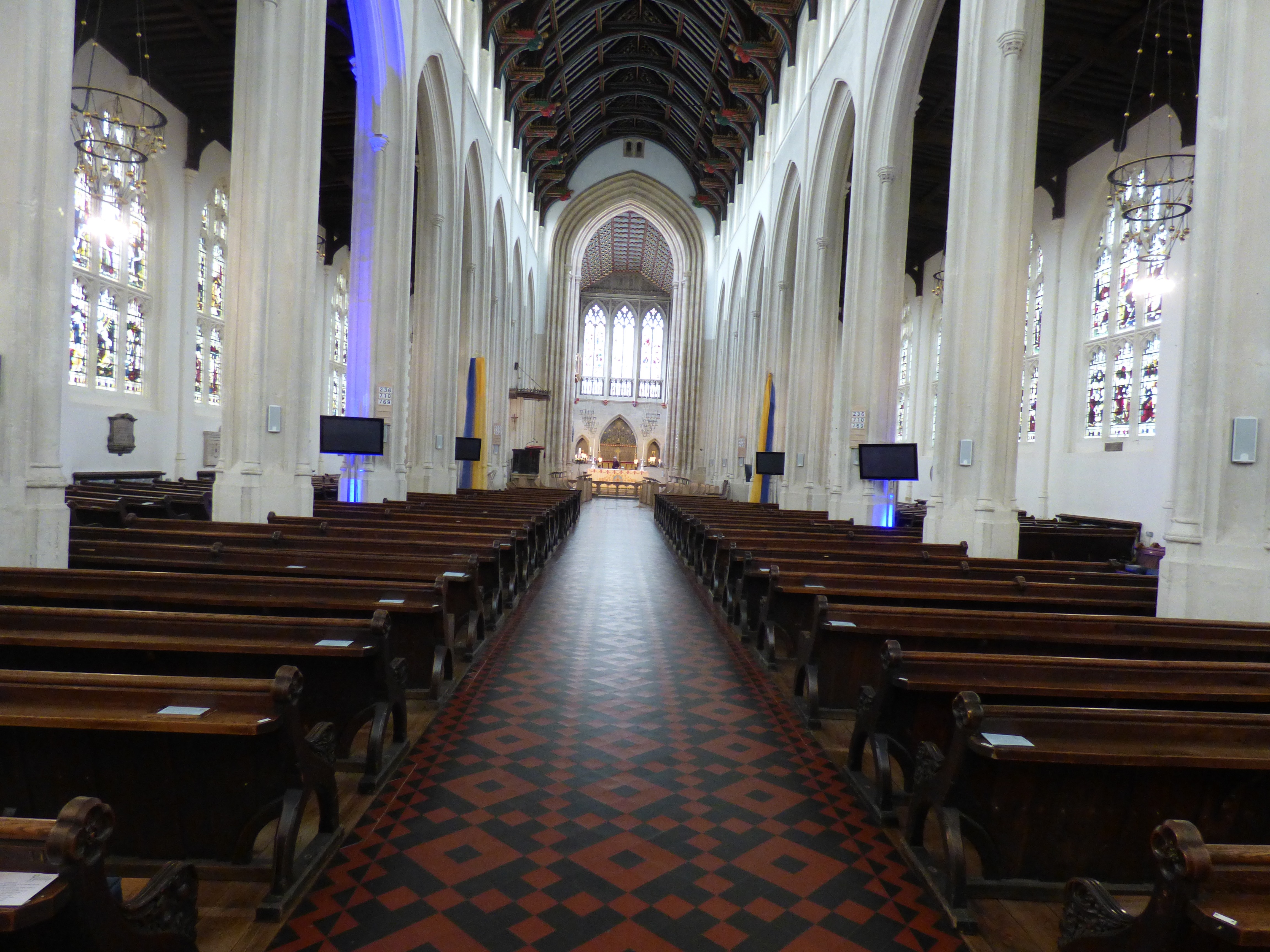
Unlike some Cathedrals that sit in a large open Cathedral Green, the entrance to Bury is from one of the main roads.


 The tower was finally finished in 2006. This view is from the area outside the cafe. There is a really good video of the tour of the tower HERE  not a tour I'll be doing .....202 steps!
The altar and it's surroundings are suitably magnificent for a Cathedral
 
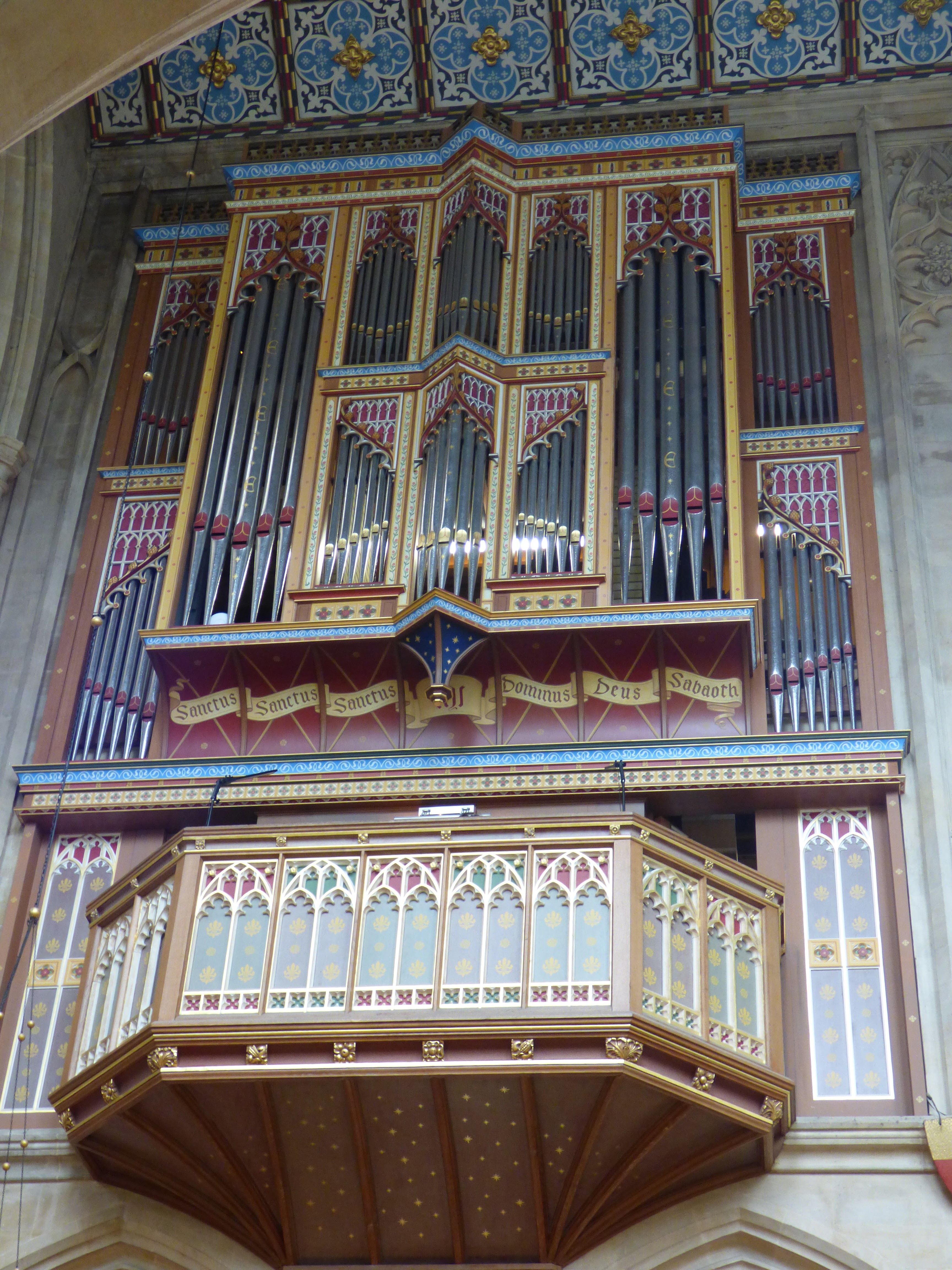
What about this for a fancy church organ!

 
Love the lights
Every window has stained glass
Each kneeler in the Cathedral is stitched with the name of the parishes in the Diocese
 
Not as big as some Cathedrals in the UK but beautiful
 
The ceiling is incredible


Bury St Edmunds is one of 4 Cathedrals in the country doing the Lego Cathedral project, it's grown a lot since my visit  in 2018.  There will be 200,000 bricks used in total. Now it's lit, the miniature stained glass windows look amazing.


This is the Cathedral's website
I need to go yet again and capture more details
 
Back Tomorrow
Sue


26 May 2022

There are old books......................

....................... and then there are VERY old books. The ones I went to look at on Monday morning fall into that latter category. My cousin and her husband had just been to see them last week when they called in for a cuppa on their way home  or I might not have heard about them.

The books were in a special exhibition at the Cathedral in Bury St Edmunds .............................


Because the books were on display in the small Treasury room visiting was by booked but free tickets. So I booked a free ticket online and went to have a look.

Hope you can read the leaflet below which explains that only 270 of the 3,000 books in the abbey survived the dissolution of the monasteries and 154 of those are in the Cambridge Universities libraries. Pembroke College has loaned seven to celebrate the 1000 years of the Abbey (it was actually in 2020 but you know what happened then).


No photos allowed of the illuminated manuscripts but they were very special . There was a screen showing a little of what they look like.


 I loved the Illuminated Letters that start each chapter.

Apologies for the poor photos of some of the boards that explain about the abbey and the Benedictine monks


Here is a link to look at the manuscripts in the collection at Pembroke College  https://cudl.lib.cam.ac.uk/collections/pembroke/1    copied from the handout below which also mentions a new book ...... Catalogue of the Medieval Manuscripts of Pembroke College Cambridge ....available for £95!


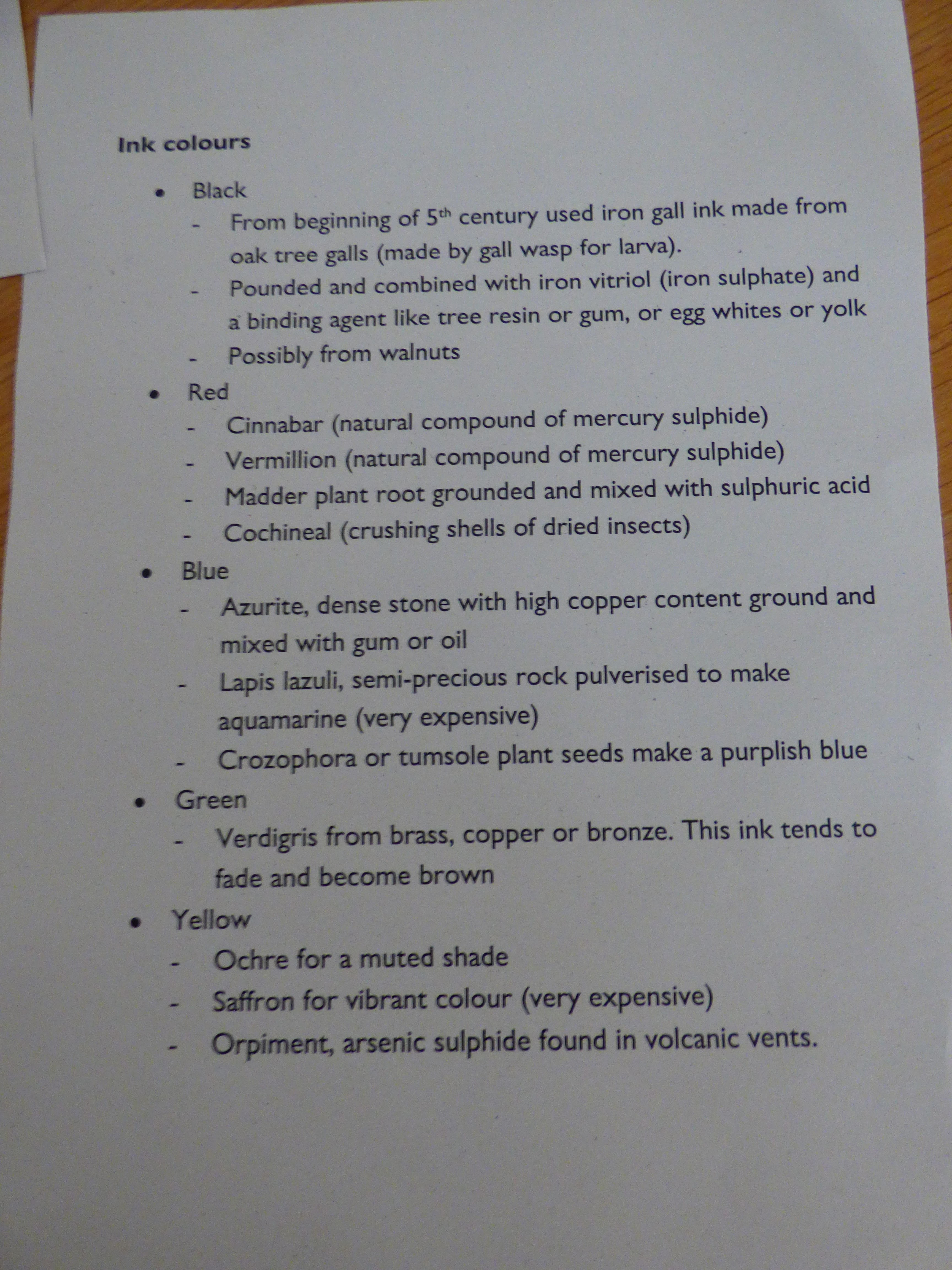
Below explains the colours used in the manuscripts


Briefly this is how the Abbey came to be here


Edmund, King of East Anglia, was killed by The Danes on 20 November 869, after refusing to give up his Christian faith. He was tied to a tree and shot full of arrows before being beheaded.

In 903 the remains of Saint Edmund, the original the Patron Saint of England, were moved to the Anglo-Saxon settlement of Beodericsworth (later known as Bury St Edmunds) where the site had already been in religious use for nearly three centuries.

St Edmund’s body was moved to London in 1010 for safe keeping when The Danes were again marauding through East Anglia but three years later his body was returned to Bedricesworth.

In 1020, King Canute had a stone church built for Edmund's body and the first abbots arrived. This was the beginning of the Abbey of St Edmund and it became a site of great pilgrimage as people from all over Europe came to visit St Edmund’s shrine.


I wrote more about the Abbey when I visited back in 2018 HERE

or the website about the Abbey is HERE


I took a few photos of the Cathedral too - for tomorrow's post

Back Tomorrow
Sue


17 August 2021

Lime Marmalade

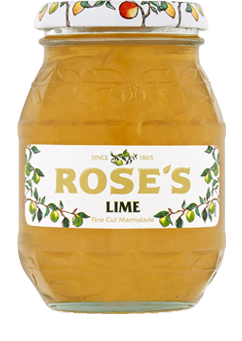
Years ago my Mum used to buy Roses Lime Marmalade, I remember it being really good (and greener)

Lime Marmalade
but when I tried a jar more recently it didn't seem to have much flavour.
 
A few years back I tried making Lemon and Lime Marmalade by mixing limes in with a tin of the prepared lemons for marmalade but the pieces of lime ending up really tough.......not nice (and even worse was I'd given some away before I knew about the tough bits!)
 
Then during my 9 weeks in holiday lets (and how quickly I've forgotten about them!) I bought a jar of Tiptree Lime Marmalade.....it was very tasty but expensive. (Tiptree are a company based in Essex)

So I searched on line for recipes and found this and made it a few weeks ago

Lime Marmalade
  • 12 limes
  • Juice of 2 lemons
  • 1.5kg (3lbs) jam sugar
  • A clean 30cm (12in) square of muslin, or an unused J-cloth
  • String
  • Four or five sterilised glass jars.
  1. Scrub the limes to remove any wax. Halve the fruit and squeeze them (reserving the juice). Place the lime halves in a bowl, cover with water and leave covered in the fridge for 12 hours.
  2. Drain and discard the water. Halve the pieces of lime, scrape out the flesh and membrane, then wrap this - together with any pips - in a bag made from a clean square of muslin or an unused J-cloth. Secure the top with some string.
  3. Slice the peel thinly and place in a large saucepan along with the muslin bag. Then add the lime juice, lemon juice and 1.5lL(48fl oz) of water. Bring to the boil, then reduce the heat and gently simmer the mixture, uncovered, for 1 hour. The peel should be tender - cook a little longer in needed.
  4. Remove the muslin bag from the pan and, using tongs, carefully squeeze any liquid back into the pan.
  5. Discard the bag. Stir in the sugar and bring to the boil, stirring to dissolve the sugar. Boil rapidly for 10 minutes or until setting point is reach (see below).
  6. Allow the marmalade to cool for 20 minutes, then stir and spoon into sterilised jars. Seal and label when cool.

Just in case it wasn't very good I used half the recipe.........which I'm glad about because the faff of preparing the 6 limes reminded me why I only use the ready prepared tins to make marmalade nowadays!

The 6 limes made this much...............4 small jars

It tastes good with a nice sharp tang but is a very poor set, I considered pouring it back in the pan for a bit more boiling but that's no fun. I'll have to eat it all quickly!
Conclusion............. don't bother again.
 
 Sorry I didn't reply to comments yesterday. I was doing some Nanna duty that involved a lot of driving and playing all day - bit tiring.
I've run out of church visits saved in drafts now so need to go out and about again further afield.
 Back Tomorrow
Sue


14 March 2019

More from Bury St Edmunds

More of storm Gareth passing by made the weather very rough yesterday. A car ahead of me had to swerve to avoid a man on a little moped or scooter as he was blown sideways out into the road. At home I found  a small pollarded willow down across the ditch. I'll need to try and haul all the branches back to my side of the ditch - although that's a job that will have to wait until things calm down a bit. It means more wood for cutting when Col's brother brings his chainsaw round.


A few more photos from Bury St Edmunds..............last week when the weather was so much better.

In the Abbey Gardens there are  a few bits of the huge Abbey that once stood here.

The River Lark runs along the edge of the Abbey Gardens and a Little Egret was padding about in the shallows under


the Abbots bridge


and a close up

Amazing to think the River was once naviagable all the way from The Wash in Norfolk right into Bury St Edmunds..... Information HERE


Now it's just a shallow stream


In the town I remembered to take a photo of this building, The Grade 1, 17th Century Cupula House. Recently rebuilt after a huge fire swept through the building in 2012

  The Cupula on top is quite unusual and the rebuild is beautiful. It's now available To Let and was used before the fire as a restaurant and before that as a hotel.

After charity shops and before the walk down to the church just had to stop for refreshment in Greggs and tried the vegan 'sausage' roll which has had good reviews - a bit tasteless I thought. I'll stick to chocolate doughnuts in future ;-)

Thank you for lots of comments yesterday. It's fun to be known as the Nanna who brings books and cakes, although madam was in quite a grumpy mood when I saw her and didn't even want the new book read........... The terrible twos!

Back Tomorrow
Sue

12 March 2019

Back to Bury St. Edmunds

Last year I went to Bury St Edmunds  to visit the Cathedral and St Johns church (HERE). But there is another church in Bury in the 100 churches book so I went back last week.
This photo of the outside is from internet


https://www.visit-burystedmunds.co.uk/images/directory/logos/St-Marys-Church-Bury-St-Edmunds-Tom-Soper.JPG
St Mary's is a huge church, the original parish church for Bury St Edmunds, and one of the largest parish churches in England. It's situated on the corner of the old Abbey site.

Stepping inside all is light and bright, there were several people there cleaning and they always have a steward on duty for information.  I spoke to a lady who had also been visiting all the churches in the 100 churches book until she had to give up driving. We both agreed that Thornham Parva is The most perfect small church and Blythburgh is amazing for it's original features.

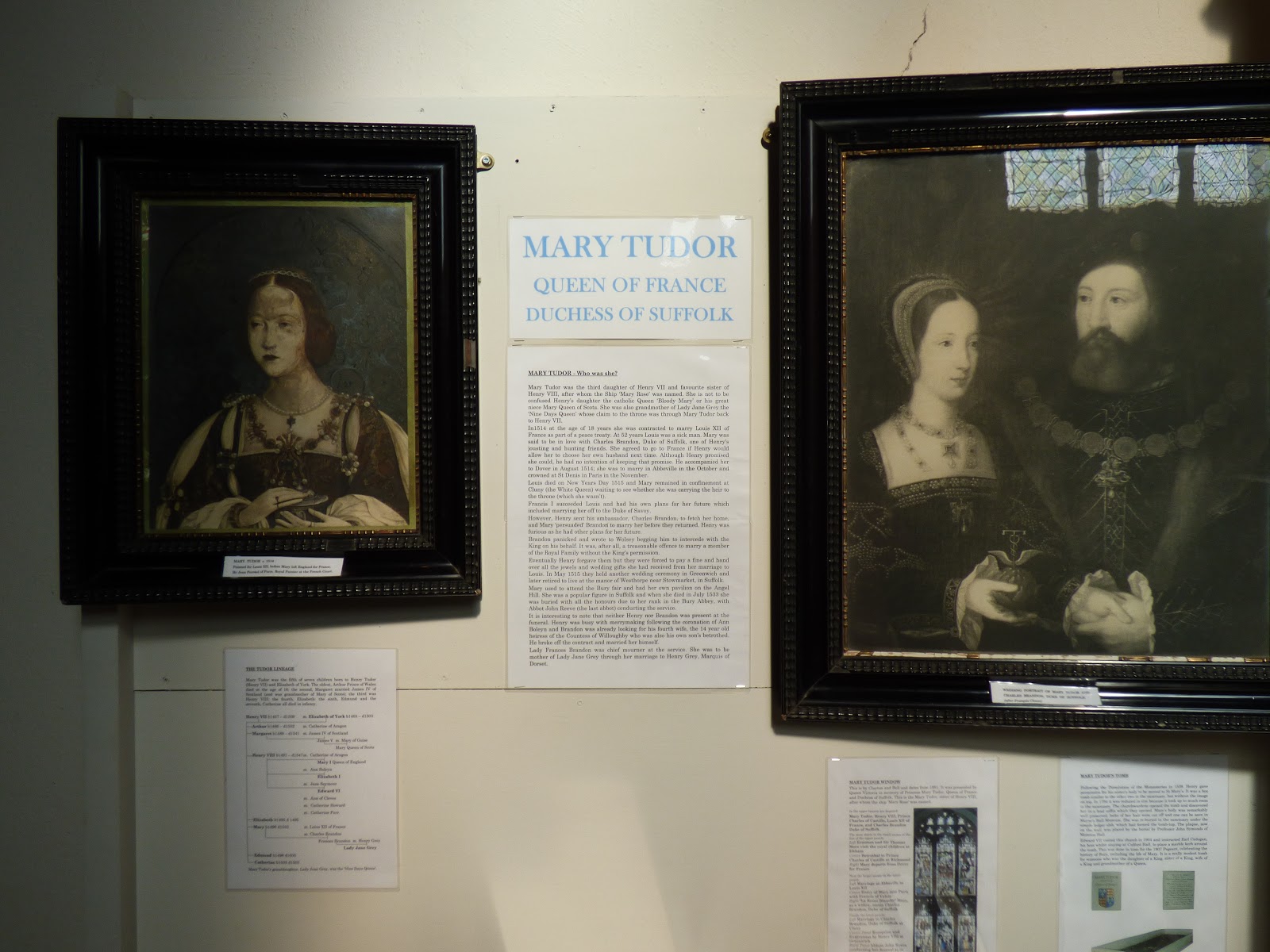
The reason this church gets it's place in the book is because of the tomb of Mary Tudor, Queen of France and Duchess of Suffolk. The favourite sister of Henry VIII. Mary became queen of France after her marriage to Louis XII and on his death married Charles Brandon, Duke of Suffolk. She died in 1533 and was buried in the Abbey in Bury. When the Abbey was dissolved in 1539 during the Reformation her body was transferred along the road to St Mary's.


More info about Mary is displayed by her tomb


As befits this big church there are some fantastic stained glass windows. This one below tells the story of Mary Tudor and was paid for by Queen Victoria.


Incredible colours and bosses on the chancel roof over the altar


This window above the chancel arch depicts the martyrdom of St Edmund and is based on a medieval pilgrims badge

The 15C roof with the large angels.


 One of 3 paintings showing scenes from the past. This is The Friday Dole - bread for the poor


There is so much more about this church on the Suffolk Churches website HERE.


Thank you for all the lovely comments about the grandchildren.

Back tomorrow
Sue