Showing posts with label Suffolk Dialect. Show all posts

25 September 2025

Suffolk Place Names

A couple of months ago someone asked about the meaning of a village name so I reserved the library book  'The Dictionary of Suffolk Place-Names". I've finally got around to writing a post .


So many of our village names in Suffolk date back to Old English - that is mid 5th to mid 12th Centuries. They often feature the name of  Anglo Saxon settlers who came here after the collapse of the Roman Empire from areas in and around what is now Germany. 
If not named from the landowner then the name often derives from the landscape where the village began.
The Doomsday Book from 1086 has the first references to almost every parish, later mentions are on  estate maps for villages belonging to the Lord of the Manor or belonging to religious Abbeys and Priories.

The names have changed bit by bit over the years until the time most people could read and write and then the spelling became more fixed, this usually happened around the mid 1700s.

These are the meanings  of  a few of the villages  in Mid Suffolk.............

Haughley = Hawthorn wood or clearing. Earlier recorded names were Hagenet,Haugle,Hawleigh

Mendlesham = Myndel's Homestead. Earlier recorded names  Melnesham, Meldeham

Wetherden = Wether Valley. (Wether is a castrated ram) Earlier names were  Wederdena, Wethirden

Bacton = Bacca's estate, farmstead. Earlier names were Bachetuna, Baketuna.

Cotton = Codda's estate farmstead. Earlier names were Codetuna, Cottuna

Stowmarket = Meeting place with a market. Earlier names were Stou, Stowe Sancte marie and but more mentions of Tornai or Tonei which became Thorney Green an area of open land on the edge of Stowmarket.

Ipswich (County Town) =. Probably from Gip or Gippis trading port/ harbour. Or an old English noun gip meaning gap or opening referring to the estuary. Earlier names were Gypeswich, Gippewici,Ipswyche. 


Something I didn't know was that while we think some village names come from the rivers that run through them it's actually the other way round. Rivers were not named until maps were needed and in common use - and the map makers would name the river from the village  sometime making up names that sounded right. 
For instance the River Lark  that runs through Bury St Edmunds, is a back formation from Lackford and has tributaries called 'The Linnet' and 'The Dove' -  names unknown until they were labelled on an early map.


Thank you to whoever asked about a village name meaning and I can't remember which name they asked about - but looking through this book has been interesting.

Back Soon

02 February 2022

The Farm Down the Lane

I'll start by apologising to Miki at Farms on my Bookshelf blog for blatantly borrowing her idea!

 
When I downsized books after Colin died and before moving I kept these three off his shelves because they are about a farm that we know that's quite local. We've owned the books for ages but I'd never actually read all the way through them.

 The books are by B.A. Steward and the oldest is Farm  Down the Lane, published in 1946 and including this lovely map.


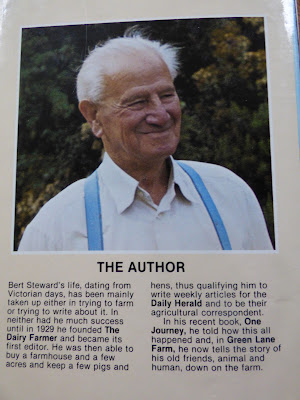
This is the author in the 1980's on the back of his 3rd book "Green Lane Farm". He was born in 1897 in Norfolk and won a scholarship to The Paston School.
 After serving in WWI he went on an agricultural training scheme for demobbed soldiers and worked on several farms, then in 1929 was appointed editor of a new monthly journal The Dairy Farmer. He was then able to purchase the 120 acre Green Lane Farm in 1937.
 
Farm Down the Lane is the story of that farm in a year through the war.  One Journey: the story of a Suffolk Farmer - his Autobiography was published in 1981and Green Lane Farm is a collection of short pieces written for The Daily Herald and the Eastern Daily Press published in 1982.
 
He sold the farm house, buildings and land in 1953 to the father of the current owner and moved nearer to the Suffolk coast to a property with just one acre. Later the Stewards retired to Felixstowe . Bert Steward died in 1993.
 
The House still looks much the same now as it does on the drawing and the 'moat' is still there and the pond on the other side of the lane.


 About half of the land was sold off many years ago and the fields still owned by the farm are let out to neighbouring farmers. They still use the buildings (some probably go back to the thirties) and the part of Barn Meadow which is closest to the house is now a garden.

I asked the owner  if any of the fields owned by the farm still have the same names and she said  Dumpling, Little and Big Smithers, Lower Riding and Garbage are still the same. They also still own the little bit of land by the pond which is "The Stackyard" - and you can see the straw-stacks on the map Over the years Nettice has become Neathouse and High Riding has become Home Riding. I love the fact that farms in the past always named their fields - this would be in the days when there were farm workers who would need to know where they were being sent to work. (When we got the deeds to the smallholding we found it had been built in 1955 on a 5 acre field called "Far Biggins" - part of a huge estate)

Of Steward's three books the earliest is the best - but gets no mention in the later books. It's full of Suffolk  words and phrases and details of the way farmers worked during the war. On the day that Italian Prisoners of war come to pull sugar-beet on the farm. Old Sam remembers the earlier war days  as he patrolled the lane with his shotgun looking for enemy parachutists.

"A rum night....planes goin' about in a hurry......dussent show a light, an' there was the ol' mare a-foalin'"
Sugarbeet was often grown during war time and just as now the weather could be a problem

"When you're growin' sugarbeet they want to be orf the land by th' end o' November, Du that awnt do to grow 'em at all"

 How many tales from the books are true? In his biography he says that he took three local villages and mixed them together and "Old Nart" one of the Suffolk characters in the books, was made up of several people he knew. So the map of the The Farm Down the Lane might be the only thing that was accurate! He was definitely more of a journalist than a farmer.


Back Tomorrow
Sue


24 May 2020

Suffolk Dialect in Lockdown!

This is how we say it in Suffolk!............Easy for us to understand!

Image may contain: text that says "STAY HOOME YEW MARN'T GOO OWTSOIDE HOWD YEW HAARD"


(This was on the Stowmarket Past and Present Page. Thanks to Don Egan for making it and allowing it to be shared around.)

Back Tomorrow
Sue


20 February 2020

What's a Groop?................

................I'm sure that's what I asked Colin in about 1979. He was working as a County Council roadman and would come home from work after digging out "groops" all day.


Back then all these roadside drainage channels - for that's what a Groop is - were dug by hand. Now they are done in quarter the time by a tractor with a small digger shovel. They've all recently been dug out where I was walking the other day.

I thought it was a word the blokes who dug them had made up and it certainly doesn't appear in the Shorter Oxford Dictionary but it is in my little book of Suffolk words.


I've written about Suffolk dialect once before on this blog HERE, and on the old blog too a long time ago when I found people didn't 'get' the ironic sense of humour Suffolk people often use and our way of using language not quite as intended.

I wrote this 

 So a "bit windy" means blowing a gale and if  someone asked me how many people were at a a big event and I said "quite a few". That means lots, even hundreds!
We use the word 'stuff' too much. For instance we would say I got some stuff from the doctor, instead of medicine.
 If I said to two people " have a good Christmas together" it wouldn't mean "have a good Christmas TOGETHER" but "have a good Christmas both of you".
The word " daft" doesn't really mean stupid but is just slightly silly or even a term of endearment!
"Funny"  doesn't always mean hilarious or even slightly amusing and "Owd" (old) doesn't necessarily refer to age. We say "Thus a funny owd day today int'it?" ( it is a funny old day today isn't it?) Which means that the weather is a bit odd or odd things have happened.
We say "Ours" or "mine" to mean our home and "yours" is your home.
We say "shew" instead of showed. The word "that " often replaces "it" and if we say " clever" it probably has nothing to do with intelligence. So "he in't too clever" means he is at deaths door!


We're proud to be a bit odd over here in East Anglia!

What's a 'groop' called in your part of the world?

Back Tomorrow
Sue

04 October 2018

Suffolk Words

In that very short recorded bit I posted the other week about staying here someone said they could hear my Suffolk accent. There used to be lots of people with broad Suffolk accents and using the dialect but now it's disappearing .
I've been clearing out more books and found this little book among some other Suffolk books.
Thought I'd test you out with some Suffolk words and dialect from the book that I've actually heard used. I'm not sure these are only used in Suffolk, they could be common country words.
Work these out..............

Airy Wiggle                                                         Fourses
Backus                                                                  Goose-gog
Bag-up                                                                 On the drag
Biggety                                                                Phoebe
Bor                                                                       A push
Carr                                                                      Rile
Chaites                                                                 Slivva                                                                
Crome                                                                  Tilt
Ewe ( not a female sheep!)                                  Ul
                                                                              Watering


Airy Wiggle is an Ear-wig
Backus is the scullery built on at the back of a house
Bag-up is a cow,sheep or goat just before calving or kidding - when the udder is filling up with milk
Biggety - bit of a show off. A Biggety-B****r was someone who thought he was better than others!
Bor - Used as a greeting between male friends " How you gettin' on bor?"
Carr - small wood or copse near water
Chaites - left over food
Crome is a garden tool with prongs at right angles to the handle
Ewe - owed " I ewe him a fiver"
Fourses - like elevenses but around 4o'clock in the afternoon, needed during harvest and haymaking when long hours were worked out in the fields
Goose-gog is a gooseberry
On the drag is running late for something
Phoebe is the sun
A push is a boil
Rile means annoying.
A slivva is a splinter of wood in your finger
A Tilt is a tarpaulin
Ul is Suffolk for  'you will' or I will
Watering  is where a steam is shallow enough for a road to go through it.

Are they Suffolk words or used everywhere? I have no idea!

If you watched Antiques Road Trip on Tuesday afternoon you would have seen the two antique experts motoring around the bit of Suffolk where we lived  for so many years. Phillip Serrell was at the Long Shop Museum in Leiston and the man there was demonstrating the use of a stirrup pump and said you put it in a pail. Mr Serrell said " hang on, that's what we call a bucket isn't it?" We always had a spade and pail for the beach when I was little, never a bucket. So is pail a Suffolk word too?

Back Tomorrow
Sue