Showing posts with label Wassail. Show all posts

06 January 2026

January 6th - Epiphany, Wassailing and Weather

The Christian festival of Epiphany, commemorating the arrival of the wise men who travelled far to visit the new baby. In some countries it is more important than Christmas Day.
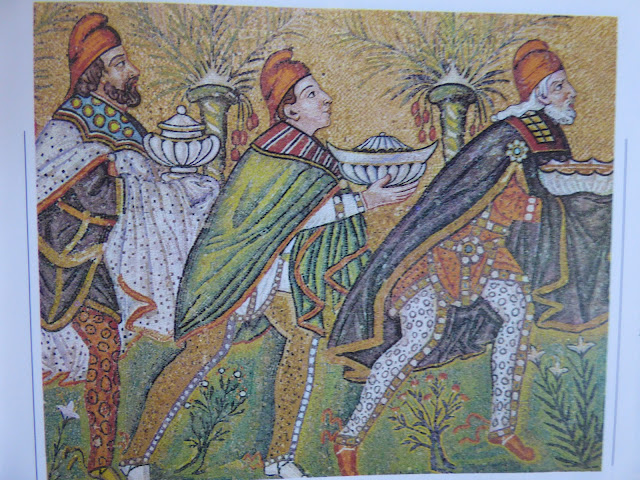

The photo above is from my book 'A Calendar of Saints' and is described as mosaic,S.Apollinaire Nouvo, Ravenna.

When all twelve days of Christmas were holidays people would celebrate the last day before returning to work on the land by lighting bonfires and baking cakes. Now it is the last day to take down the Christmas decorations to avoid bad luck.

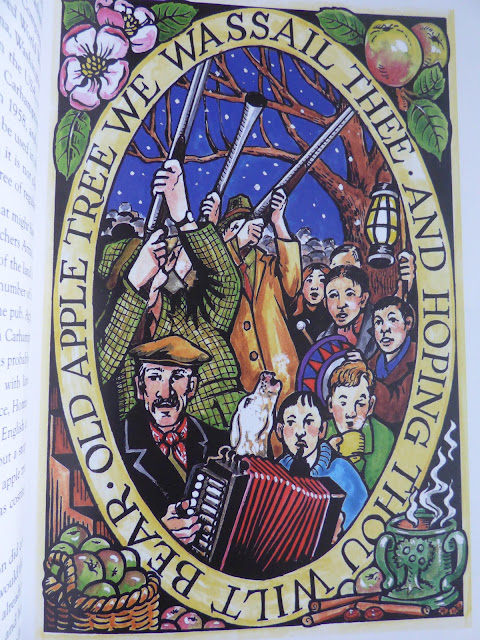
Wassailing the Apple trees on Twelfth Night (or old Twelfth Night on the 17th) is a tradition that's been revived in some cider making regions of this country. Cider is poured on the apple roots and toast soaked in cider hung on the branches of the trees then shots fired through the branches to frighten off evil spirits and songs song to encourage the trees to fruit. Most years I venture out into the cold to pour some cider on the tree roots of my trees but no shooting!

There's a gathering in an Ipswich park on Saturday - bit too far for me to bother going. Village events seem to happen mainly in Somerset, Herefordshire and Sussex. Suffolk isn't known for it's apple orchards although there are a few.


 This below is  different to the well known wassailing rhyme, I'd not come across it before.


Wassail the trees, that they may bear
You many a plum and many a pear;
For more or less fruits they will bring
As you do give them wassailing.

Robert Herrick (1591-1674)

This is the more well known rhyme 

Old apple tree, we wassail thee, and hope thou wilt bear
For the lord doth know where we shall be, till apples come another year
To bear well and bloom well so merry let us be 
Let every man take off his hat and shout to the old apple tree..........
SHOUT ......
Old Apple tree we wassail thee, and hope that thou will bear
Hats full, caps full, three bushel bags full,
And a little heap under the stair.

 Wassail means "be healthy" and as farm workers were often paid in cider during the harvest it was important the trees were healthy and produced plenty of fruit......... at one time there were 400 varieties of cider apples and an orchard on every farm in every village.

There was a surprise when I opened the curtains yesterday morning - Snow - not a lot but enough so that the two grandchildren didn't spend the day here after all and my Monday walk in sunshine was even shorter and quicker than Sunday.

17 January 2024

Old Twelfth Night and Wassailing

 I didn't get outside to Wassail my small apple trees on the modern twelfth night on the 6th - it was probably raining, so must do it tonight which was twelfth night before the calendars changed in 1752. It was still called 'old twelfy' in  parts of the country up to the C19. I have a can of cheap cider in the cupboard right ready.

Wassail is a very old word, coming from the Anglo-Saxon  Drinking toast  "Waes Hael" meaning "be of good health" to which the answer was "Drinc Hael". This has been recorded in old medieval English and earlier in the epic 'Beowulf' poem and there is also a toasting scene on the Bayeux Tapestry. It was definitely well known by the mid C13 not just as a personal drinking toast  but as a festive occasion around Christmas with drinking and entertainment.

On Twelfth night in the past there were two different types of Wassailing. The first was moving door to door around the village singing and carrying a wassailing bowl and the second was a ceremony taking place in orchards, blessing the trees for a good crop next year. In the C19  farm workers were often paid in cider during the harvest, so it was important the trees were healthy and produced plenty of fruit......... at one time there were 400 varieties of  apples and an orchard on every farm in every village and an apple tree in every cottage garden. 

The tradition has come and gone and then "reawakened" more recently, often by groups of Morris Dancers and folk singers.

So that's what I'll be doing, blessing the apple trees and pouring cider on the roots, although I won't be shouting - the neighbours are a bit close for that!


Old apple tree, we wassail thee, and hope thou wilt bear
For the lord doth know where we shall be, till apples come another year
To bear well and bloom well so merry let us be 
Let every man take off his hat and shout to the old apple tree..........
SHOUT ......
Old Apple tree we wassail thee, and hope that thou will bear
Hats full, caps full, three bushel bags full,
And a little heap under the stair.
Hip, Hip Hooray!


All the information here comes from my book, which I found at a car boot sale a few years ago.


Back  Tomorrow
Sue

06 January 2023

Wassailing Again

Apologies as I've probably mentioned this nearly every year (shortage of ideas for blog posts every January!)

On Twelfth night in the past there were two distinct types of Wassailing. The first was moving door to door around the village singing and carrying a wassailing bowl and the second was a ceremony taking place in orchards, blessing the trees for a good crop next year.

 Wassail  (From the Norse Waes Hael") means "be healthy" and as farm workers were often paid in cider during the harvest it was important the trees were healthy and produced plenty of fruit......... at one time there were 400 varieties of cider apples and an orchard on every farm with apple trees in every cottage garden.

Around the village they would sing this old traditional song which I've always known, from somewhere...primary school perhaps


Here we come a wassailing among the leaves so green
Here we come a wassailing so fair to be seen
Love and Joy come to you and to you a wassail too
And may God bless you and send you a Happy New Year
And God send you a Happy New Year

God Bless the master of this house and Bless the mistress too,
And all the little children that round the table go,
Love and Joy come to you and to you a wassail too
And may God bless you and send you a Happy New Year
And God send you a Happy New Year

And in the orchards this poem would be chanted while drums were banged, rifles fired through the tree branches, bread soaked in cider laid on the branches of the oldest tree and cider poured on the roots.

Old apple tree we wassail thee
And hoping thou will bear
For the Lord doth know where we shall be
‘Til apples come another year
For to bear well and to bloom well
So merry let us be
Let every man take off his hat
And shout to the old apple tree
Old apple tree we wassail thee
And hoping thou will bear
Hats full, caps full, three bushel bags full
And a little heap under the stair
Hip! Hip! Hooray!

Wassailing the apple trees is still happening in parts of the country - specially in the cider orchards of Somerset and Herefordshire and now Morris Dancing sides or Community Orchard Groups have got the tradition re-started in many places. I only know of one in Suffolk, at a country pub with the Old Glory Molly Dancers performing, but a bit too far away for a visit.

This is a book I found a few years ago at a boot sale written by the same people as my Ogham Tree Alphabet book. It's a fascinating look back at traditions - old and new. 


It's also a Full Moon tonight, January full moon is called the  Wolf Moon and is a micro-moon, which is the opposite of a super moon, so the moon will appear smaller than usual at it's furthest point from the earth.
I only need to step across the patio and out onto the lawn to do the Wassailing tonight. Then it's up to nature to do the rest.

Back Tomorrow
Sue

06 January 2022

January 6th Twelfth Night and Epiphany

Epiphany is the  Christian Feast day marking the visit of  the Wise Men from the East bringing their gifts to the baby Jesus. 

The photo above is from my book 'A Calendar of Saints' and is described as mosaic,S.Apollinaire Nouvo, Ravenna.

January 6th is the day celebrating Balthasar, Caspar and Melchoir  but nowhere in the Gospels does it say there were 3 wise men although as there were three gifts that was deduced early on. In the Book of Psalms it says The Kings of Tharsis and the Isles shall offer presents and the Kings of Arabia and Saba shall bring gifts. This prophecy was soon linked to the wise men and in the 2nd century they were given the names mentioned above.

Twelfth Night has two traditions. First is that all Christmas decorations should be taken down, although years ago Christmas festivities went right on until Candlemas(Feb 2nd) and it was only then that the greenery had to be taken down and burned. 

Secondly it's the day to Wassail the Apple trees when cider was poured on the roots and toast soaked in cider was hung in the branches. 

From the book "Wassail"
 

This tradition was kept going or revived, especially in the West Country and Herefordshire and by me for several years at the smallholding and Clay Cottage. It's going to be years before I see any apples on my baby trees here but perhaps I should pour a carton of apple juice over them to keep the tradition going.

Old apple tree we wassail thee
And hoping thou will bear
For the Lord doth know where we shall be
‘Til apples come another year
For to bear well and to bloom well
So merry let us be
Let every man take off his hat
And shout to the old apple tree
Old apple tree we wassail thee
And hoping thou will bear
Hat fulls, cap fulls, three bushel bag fulls
And a little heap under the stair
Hip! Hip! Hooray!


Back Tomorrow
Sue


06 January 2020

Twelfth Night, Epiphany and Wassailing

Hiya, I'm back - not that I've been anywhere. Many thanks for comments on the New Year post. Having a few days off blogging has given me time to sort out some things to write about for at least the rest of this week.

I don't know if  it was an omen for a good year but opening the bedroom curtains yesterday morning I spotted a hare passing through the garden - it's been a while since I saw one. (Although later I found a half dead mouse in the living room - don't know what that foretells for January!)

 
The Twelfth night after Christmas marked the end of Yule festivities. All decorations had to be taken down and the holly and other green stuff would be burned. It was once thought that every holly leaf left indoors after this date would turn into a mischievous spirit.
In medieval times there would be games and feasting  and in Tudor times a masque or play would be presented and it was usual back then to have a Twelfth Night Cake which had a bean baked into it and whoever found the bean would be King for the day. That custom faded away when Christmas cakes became more popular.
Epiphany is the  Christian Feast day marking the visit of  the Wise Men from the East bringing their gifts to the baby Jesus.

My favourite thing for Twelfth Night is wassailing the apple trees. I've been doing this for years and it never makes any difference to the amount of apples but I'm ever hopeful. Last year was a poor crop - not quite as bad as 2012 but almost.

 Although there is an old saying
Sun through the Apple trees on Christmas Day means a fine crop is on the way.
And there was sunshine here on Christmas day - so maybe this year will be better.  


 This year I was able to find out more about Wassailing from the book that I picked up at a boot sale last September. It has stories of old celebrations and accounts of all the "Re-awakenings"..........  that is new events that have started since the mid C20.


 Also found this recipe  for a traditional Suffolk Wassail drink (according to a Lavender and Lovage website) Although in my 64 years in Suffolk I've never heard of it before.

Ingredients
  • 6 small apples, cored
  • 6 teaspoons soft brown sugar
  • 1 orange
  • 6 cloves
  • 200g caster sugar
  • 2 litres cider
  • 300mls port
  • 300mls sherry or Madeira
  • 2 cinnamon sticks
  • 1/2 teaspoon ground ginger
  • 1/4 teaspoon ground nutmeg
  • 1 lemon, halved

Step 1 Pre-heat oven to 200C/400F/gas mark 6.
Step 2 Cut around the middle of each apple with a sharp knife and place them in an oven proof dish. Fill each apple core cavity with a teaspoon of sift brown sugar. Stick the cloves in the orang and place it with the apples in the dish. Add a little water, about 6 tablespoons and roast in the pre-heated oven for 30 to 45 minutes, or until the apples are soft but still retain their shape.
Step 3 Leave the apples in the dish to keep warm and take the orange out - cut it in half and place it on a large sauce pan. Add the rest of the ingredients and the juices from the apple roasting dish to the sauce pan and gently heat until the sugar has dissolved.
Step 4 Bring the mixture to the boil and then turn it down immediately and keep it warm until you need to serve it.
Step 5 When you are ready to serve the wassail, ladle the fruit and spiced into a large punch bowl and then pour the wassail into the bowl. Add the apples by floating them on top and serve straight away in warmed mugs or cups.
Step 6 The apples can be eaten afterwards as a delectable dessert with cream or custard

 Sounds good to me..................... although I have no plans to make any.

My celebration involved soaking a bit of toast in apple juice and laying it on one of the biggest branches of the biggest apple tree and then pouring some apple juice on the roots......it should be cider but that's not something I have around................maybe that's why it doesn't work?
Then while hitting the apple tree trunk with a stick you have to chant .

Old apple tree, we wassail thee and
hope that thou wilt bear
Hats-full, caps-full, three-bushel bags full
And a little heap under the stairs
Hip Hip Hooray 

I've found this verse is actually the last bit  of a longer wassailing song..............

Old apple tree we wassail thee
And hoping thou will bear
For the Lord doth know where we shall be
‘Til apples come another year
For to bear well and to bloom well
So merry let us be
Let every man take off his hat
And shout to the old apple tree
Old apple tree we wassail thee
And hoping thou will bear
Hat fulls, cap fulls, three bushel bag fulls
And a little heap under the stair
Hip! Hip! Hooray!

In some places celebrations include firing guns through the branches, I don't do that....obviously, and I have to chant quietly to avoid worrying the next door neighbours!

If the weather is too awful for wassailing Apple trees on this Twelfth Night it's OK to put it off until the 17th which is 'Old Twelfth Night' using the calendar which was in use until 1752.

Back Tomorrow
Sue


06 January 2019

6th January

The Christian festival of Epiphany, commemorating the arrival of the wise men who travelled far to visit the new baby. In some countries it is more important than Christmas Day.

When all twelve days of Christmas were holidays people would celebrate the last day before returning to work on the land by lighting bonfires and baking cakes. Now it is the last day to take down the Christmas decorations to avoid bad luck and the last day of eating a daily mince pie for good luck.............if that's what you've been doing!

Wassailing the Apple trees on Twelfth Night (or old Twelfth Night on the 17th) still takes place in some cider making regions of this country. Cider is poured on the apple roots and toast soaked in cider hung on the branches of the trees then shots fired through the branches to frighten off evil spirits and songs song to encourage the trees to fruit.


Ramblings ~: All things Wassail


Old apple tree, we wassail thee, and hope thou wilt bear
For the lord doth know where we shall be,till apples come another year
To bear well and bloom well so merry let us be 
Let every man take off his hat and shout to the old apple tree..........
SHOUT ......
Old Apple tree we wassail thee, and hope that thou will bear
Hats full, caps full, three bushel bags full,
And a little heap under the stair.

 Wassail means "be healthy"and as farm workers were often paid in cider during the harvest it was important the trees were healthy and produced plenty of fruit......... at one time there were 400 varieties of cider apples and an orchard in every village on every farm.


 Here's some Wassailling from Somerset in 1979


Then of course there is the Twelfth Night that is the comedy by William Shakespeare. This is the only play by Shakespeare that I've ever read and that was because we "did" it for O Level back in 1971.......(Along with Jane Eyre and some poems from the Book of Narrative Poetry) Although I failed English Literature at least it didn't put me off reading because I haven't   stopped reading since then................ But no more Shakespeare or Brontes.

Back Soon
Sue