Showing posts with label Natural world. Show all posts

18 June 2026

Dunnock

 Years ago when we saw one of these in the garden it would have been called a Hedge Sparrow but it's properly named 'Dunnock'. (Prunella modularis).The only British member of this family.

They are common and widespread except for the very North of Scotland. Seen in woodland, hedges and gardens. They build a nest close to the ground somewhere really well hidden in thick hedges, evergreens or bramble thickets, so don't normally use nest-boxes.


Quite shy little birds I don't often see them here but that might be because they are usually at ground level, hopping about under the feeders rather than up on the feeders or in the shrubs that I would see from the window more easily.


Back Soon


04 June 2026

Hummingbird Hawk Moth

 The problem with Hummingbird Hawkmoths is that they don't sit still for photos.

The hummingbird hawk-moth migrates to the UK from Southern Europe each year. It can be seen hovering over flowers, feeding with its long proboscis; its wings move so quickly that it 'hums'.


This is only the third time in all my years of having a garden that I've seen one. It was on the Valerian which is one of those plants that just arrives and spreads.

Red valerian was introduced in the 1600s from Europe, but is now naturalised in the UK. Its pinky-red flowers grow from old walls, roadside verges, railway cuttings and cliffs, and provide nectar for insects.


Hooray for patches of garden where anything is left to grow and to being in the right place at the right moment to spot this intriguing creature.


Back Soon

20 May 2026

May 20th World Bee Day

 Today is World Bee Day 

World Bee Day is celebrated on 20th May each year, marking the birthday of Anton Janša, a pioneer of modern beekeeping. The event is designated by the United Nations to raise global awareness of the importance of bees and all pollinators.

There are now lots of websites about bees, spotting, identifying and recording. This was one website that popped up........... The Bumblebee Conservation Trust

This information sheet I've had around for ages and now it's stuck in a scrapbook to keep


This photo below is from May 2024 when the Ceanothus (Californian Lilac) was buzzing with all sorts of bees, this year the flowers are just as blue and beautiful but with the colder spring and chilly wind there are very few bees about.


I picked up this leaflet about spotting Yellow Legged or  Asian Hornets from somewhere last year, thankfully not established in this country yet, although they are spreading. They are predators of honey bees and other pollinators and were first spotted in the UK in 2016. Thank goodness for monitoring and eradication but still 120 sightings were recorded up to summer of last year. All sightings must be reported . This is a link HERE


Back Soon

24 April 2026

Mute Swans

Don't ask me why, but I've been watching the very cringingly cosy and unrealistic crime series 'The Marlow Murder Club' on the 4 Catch up channel or maybe on the U channel- can't remember which. In one programme they  mentioned Swan Upping on the Thames which reminded me I had this cutting from last years folklore diary.


The nearest swans to visit from home are at Needham Lake - next to the car-boot sale field, so I went to take a photo- as you do when you have a blog and posts to fill!!


There is a really good page about Swan Upping HERE. It looks like a very colourful occasion.


A salute to Queen Elizabeth II, Seigneur of the Swans
A toast to Queen Elizabeth II

Back Tomorrow

08 April 2026

Finding Out.

  Walking through the church yard across the road from home I noticed so much of this tiny plant, it wasn't familiar to me, yet it was everywhere and I don't like not knowing what something is.


Eventually found it in this book


There it is...........Field Woodrush. Latin name Luzula campestris.


I discovered it has a common name of "Good Friday Grass". I found it on Easter Saturday! .

 "A short tuft forming rush, the leaves are fringed with white hairs. It's brown flowers, appearing from April to May,  form clusters on top of greenish stems. Common and widespread."

The yellow on my sprig is pollen and a lot was left after picking it up from where it was laying on  my laptop for the photo. Hope it's a pollen of use to bees etc as there was plenty of it in the churchyard.

Back Tomorrow


10 October 2025

Acorns Today After Oaks Yesterday

 Everyone agrees that it's an amazingly good year for acorns. This is an oak on the top bit of the car boot field at Needham Market (when the site wasn't full of people selling) and the ground is absolutely covered.


The early morning Farming programme on Radio 4 last week had a bit about Pannage in the New Forest, which I knew I'd written about a while back. Thanks to the post search feature I found it - I'd repeated it just last year. I love what an amazingly old system it is. HERE is a bit from wiki about the Agister which is an official, dating from medieval times, looking after the people who have rights of pannage.

Pannage is an ancient practice that is still used today by commoners and verderers who turn out their pigs into the Forest during the season.  The pannage season, usually between September to December, lasts around 60 days. This year's season (this would have been the year I first posted this info) will run between 13 September to 14 November  Pigs do a vital job of eating many of the acorns that fall at this time of year. Green acorns are tasty for them, but poisonous for the ponies and cattle that roam the area freely.


I found this rhyme about pigs eating acorns out of season....

Though good store of acorns the porkling do fat
Not taken in season may perish of that,
If pig do start rattling and choking in throat
Thou loosest thy porkling - a pig to a groat!


Acorns can be turned into flour - but it's quite a long process as they are toxic unless properly prepared, shelling is the start and that's enough to put me off, then there is leaching out the tannins, drying, grinding, drying. 
There's a website HERE if you want to see how, I'll stick to buying a bag of flour from a supermarket!

During the war they were used as a substitute for coffee often called an ersatz coffee, especially in occupied countries where coffee completely vanished from the shops. There's a youtube video below or HERE. which makes it look quite simple. 


When I did the Following a Tree posts  last year I had photos of the oaks up the lane all through the year but there weren't  as many acorns as this year and I never looked in the  Cecily Mary Barker Flower Fairy book to see if there was an Oak Tree Fairy - there isn't, but in the Autumn Fairy section I found an Acorn Fairy and his song.


Back Soon


09 October 2025

Oaks Today and Acorns Tomorrow

 Last year I did the Following a Tree posts when I took photos of how the oak  trees up the lane changed each month.

From January 2024

Through the height of summer

and to November 2024.

On the February 2024 post I wrote a bit about the natural history of oaks and this year the huge quantity of acorns made me want to write about them too but then I kept finding more about oaks so thought I'd do an extended oak post...............which sounds like something used for a garden fence! 

Oak trees are one of 500 trees of the Quercus family. The largest and longest-lived of Britain's native trees.

The monarch oak, the patriarch of trees,
Shoots rising up, and spreads by slow degree;
Three centuries he grows, and three he stays
Supreme in state, and in three more decays.

John Dryden                             

In the past oaks were often used to mark the boundaries of English parishes and local dignitaries and villagers would "Beat the Bounds" and walk the boundaries once a year reciting passages from the gospels.

In plant lore the oak is a symbol of courage, independence, faith, longevity, fire, stability, honour and reward. The tree was sacred to the sky and thunder gods, particularly Jupiter, the supreme deity of Roman mythology and was known as Jove's tree and could not be struck by lightening in a storm.

Oaks are one of the last trees to lose their leaves. (Walnuts and Horse Chestnuts are usually the first)

If on the trees the leaves still hold
The coming winter will be cold.

The oak is a symbol of England and was on the badge of the Stuarts. A sprig of oak leaves was worn in button holes and caps on 29th May to commemorate the birthday of Charles II who hid in an oak after the battle of Worcester in 1651.

The oak had all sorts of uses in medicine. Culpepper said the bark, leaves and powdered acorn cups 'bind and dry very much'. The inner bark and the thin skin covering covering the acorn was advised for those spitting blood, while the bark and powdered acorn was said to be an antidote to poisonous herbs and medicine.

Oak galls, formed by the larvae of the  gall wasp were used to make ink and dye. Up to the C18 large households would have made their own ink. A recipe from the 11th century, quoted by Dorothy Hartley in her book "Made in England" says   "12lbs of oak galls pounded, 5lb of gum(gum arabic) pounded, 5lb or less of green sulphate of iron, 12 gallons of rainwater boiled each day till sufficiently done, letting it settle over night".

More than you ever wanted to know about Oak trees!

Acorns Tomorrow 


30 September 2025

Fields Full of ?

 There are several fields not far from home growing a mystery crop this year.

It's very colourful with seed heads of red/purple, yellow and green.


 Is it a crop grown for Caribbean cookery? Seem to remember seeing crops like this on programmes about city allotments where people of all nationalities grow crops we don't often use here.

Must be grown for the seeds, there are plenty on each plant


Maybe it's Amaranth? or Quinoa?

The leaves are a bit like Fat Hen - a common weed here that was once eaten, so it's from that family.

Someone will know, but whatever it is, it's definitely not been grown around here before.

Back Soon

19 August 2025

Dragonflies

 It came in the wide open door and crashed around at the window, then it thought it was stuck (the window was just open a fraction) and stayed still for me to take a photo.

It went in a hurry when I opened the window fully.


They really are strange creatures. Years ago when I worked in Stowmarket old library we used to get them coming in all the time in summer. The library was surrounded by trees, cool and shaded in summer. Sometimes people in the library were terrified, no idea why as they aren't dangerous all we could do was  to open all the windows and hope the dragonflies would find their way out.

Did you know there are around 3,000  species, most live in tropical regions with 36 species in the UK. Such an ancient creature that their ancestors were around even earlier than the dinosaurs. Some are incredibly colourful - all that beauty for a lifespan of 7 - 56 days.

 I think this one is quite common -  Ophiogomphus cecilia or green snake-tail (once I started looking at all the dragonfly pictures on different websites, things got very confusing). If I've identified correctly it says the species is viable and stable - there is no concern for population decrease. Although apparently in the last 60 years two other species have vanished from the UK.

More Info HERE on one of the many websites I looked at.

Back Soon


19 July 2025

Thistledown and Ice Cream

 Schools are finished for the long summer holiday so I expected the weather to turn wet and horrible this weekend. And sure enough,  thunderstorms are forecast for Monday and showers all next week - I'll get those cards made that were on yesterdays post! Thank you for the comments about them and to the many comments on my post about the Commonwealth war graves. Please go back and read them from around the world if you didn't see them all.

So what's been happening this week (After tennis) promised not to mention it again so it's whispered in small letters.

Last Monday was quite breezy and all day the garden was filled with thistledown and as it was hot doors and windows were open so very  soon there was nearly as many inside. The hedges, shrubs and cobwebs  caught so many and indoors they also found all the cobwebs that I miss - like under the wood-burner!

Here are a few caught on the cobwebs on the whirly washing line

On Tuesday a butterfly that hadn't visited so far this summer popped in. A lovely Comma and then  there was rain in the evening - not a lot but every little helps.

 
Great British Sewing Bee is back on TV. I watch in envy at what they can whip up in 30 minutes - it would take me that long to set up the thread!

On Wednesday I had the last of six in the arthritis management and exercise course. My knee is definitely feeling less painful - especially at night - but stairs will still be a problem - if I had any to use here. Starting in six weeks time I'm going to do another more general exercise thing for another six week course called something like 'move and thrive?' Free again and run by the same young physio fella and same exercises as the eight we've been doing but with a few extras thrown in - cycle and treadmill. I forgot to ask how long it lasts each time - much less than an hour I hope - not sure how I'll get on either. 

Friends from Essex visited on Thursday for a couple of hours. I don't see them as often as when Col was alive and we were at the smallholding- we had a good catch up as they hadn't been up since November.

Friday I decided on a trip down to the sea before the weather changes- hadn't been this year at all. I underestimated just how hot it was so after a walk along the prom - the big wheel was shut - I'm still waiting to go on it sometime, and  a whippy ice cream  I went into town where it was even hotter and popped into the huge second-hand bookshop where I found an old Nevil Shute book.


Then home again through the horrible roadworks over the Orwell Bridge - which have been holding people up for weeks.
No plans to go to Felixstowe again this year - it's not worth the hassle. The A14 has become a real problem - as busy as any motorway but only two lanes and numerous junctions, frequent accidents and incidents.
At home the garden was once again full of thistledown - I reckon it's coming from the huge field down the road that's going to be a building site sometime next year - unless the company that own it sell it on again. I know of two new new housing estates nearby where building work has stopped -money problems with both is supposedly the reason. The government say how many houses are needed and have to be built but when 100s are built at the same time there's not enough people to buy them! 

Whoop Whoop, new series of Karen Pirie starts on ITV Sunday evening!  based on a book by Val McDermid (I've never been able to get into her books for some reason) . Better re-watch the first series as it was on in 2022 which seems an age ago now.

Back Next Week

09 July 2025

Wasps

 Who invented wasps? and why? What nasty trick was God playing that day!?

There were three pears on my young pear tree ...................


............................now there are none.

And this is why. A friend said they sting the pears which gives them a way in to the flesh, but they don't. - they just nibble their way in, especially when the weather is dry and they are looking for moisture as well as food.


Actually on closer inspection the critter on the pear above could be a young hornet, it flew away anyway so didn't get killed. I'm sure it's not one of the invasive Yellow Legged or Asian hornets - thankfully.

Definitely smaller common wasps below on a blurry photo as I didn't get too close for this photo of dozens of them on the pear that had fallen off.


I'd already killed dozens more the day before that were on the ground drunk and dazed after they'd had their fill of the first pear.

I've not been stung yet this year - thankfully, but there must be a nest not too far away for there to be this many all at once, so it may yet happen. 

Yes,  they are good for pollination and some feed on aphids and carrion. But I'm still not a fan.

And isn't it odd that if a cat, dog or human gets stung in the mouth by a wasp it can be a nasty business, but birds eat wasps with no problem. A young Thrush was picking up the wasps that had fallen drunk from pear juice onto the grass, giving them a good shake and eating with no ill effects.

The wasps will be needing moisture over the next few days - as will the humans- the temps are set to rise for another mini heatwave ....that's an English heatwave not a Hot Country heatwave!  

Back Soon

25 June 2025

A Garden Full of Twittering

 One day the garden was full of puffball baby Bluetits, little things shouting for food which the parents were giving them from the sunflower heart feeder. I couldn't get a photo as nothing sat still long enough.

A week or so later it was the twittering of baby Goldfinches and parents, the babies were being fed from the Niger seed feeder. Neither birds had nests in the garden but they seem to have brought the fledglings here for their meals.


Thank you to everyone for comments yesterday  about the nearby growing crops and vegetarian/ omnivore. My diet includes very little meat now - definitely no beef, but it's good to have a choice. I've lived all my life among fields and farms so grown up knowing about all sorts of crops and how things work.

Back Soon


10 June 2025

Speedwell

 When we were young we called it 'Bird's Eyes', one of it's common names, along with Angel's eyes. It grew in many places and was very common.

It's real name is Germander Speedwell and it's part of the large Veronica family (Veronica chamaedrys). There are garden varieties but the photo is of a tiny patch growing in the grass on the edge of the 'lawn'. It spreads by creeping and does no harm, yet according to the RHS website some people need to know how to remove it from their pristine lawns.


When I left a patch of grass unmown for No Mow May last year all I got was grass so it was nice to spot these in a corner by the sink-pond.

It was traditionally supposed to be effective against spells, and the flowers were said to be like St Veronica's 'kerchief, which was impressed with the face of Christ after she wiped Christ's eyes (but with her veil not a handkerchief, so that's confusing!)

And of course whenever a wild flower gets a mention, the fairy from the Complete Book of Flower Fairies by Cecily Mary Barker, first published in the 1920's, has to be included.


And his song/poem

Clear blue are the skies;
My petals are blue;
As beautiful too,
And bluest of eyes.

The heavens are high:
By the field-path I grow
Where wayfarers go
And "God Speed," say I;

"See here is a prize
Of wonderful worth:
A weed of the earth,
As blue as the skies".

I won't be digging it out as per the RHS website but will leave it to spread as far as it likes.


Back Soon
Sue

04 June 2025

Chaffinch

 I was standing talking to BiL in his back garden recently when a bird started shouting loudly from one of the shrubs. It flew out so I could see it was a chaffinch which made me realise how rarely they are seen now. I've never seen any on the feeders here. BiL's garden backs onto fields and although he only feeds birds with sunflower seed hearts he gets more variety on the feeder than I do here.

In the book 'An Illustrated Country Year' by Celia Lewis it says they are common and they are common in many parts of the country. I remember them hopping around the table when we were having coffee and cake outside at a café in Cornwall or Devon many years ago, like sparrows would have done in Suffolk, now sparrows and chaffinches are both harder to spot .


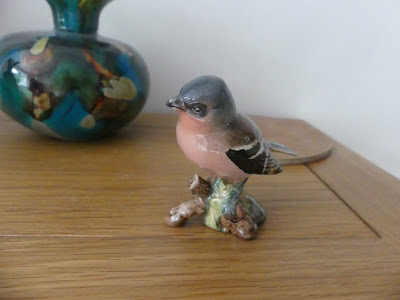
Then by a weird coincidence at Bank Holiday Sunday's car-boot sale I spotted this and picked it up to look at the base and yes it was another Beswick bird, question was, was the lady selling a dealer and would want a few £ or just someone clearing out? So I asked how much and when she said 50p it had to be bought!


Oh dear, I did say there would be no more but I now have 3 Beswick birds, that's almost a collection. The Wren and Blue tit will come out of the box for spring and the Chaffinch will be for Summer, that way they won't be dust collectors and I won't get fed up with them.

June on the bookshelf looks like this..........

The piece of Poole pottery shaped like a buoy (it's a small bell) was found in a Charity shop in Ipswich in 2022 , it hasn't been out on display before because it got wrapped up and tucked in a corner of the box that I keep all the bits in and kept getting missed . I had a sort out a few weeks ago and found it. About time it was out of the box!


Back Soon


27 May 2025

In Which I Try Out My New Binoculars and Fail at Phone Photos

 Please can someone invent binoculars with a camera that takes a photo of what you are looking at! 

I've just googled and they seem to have been invented already!

Decided I couldn't carry my new binoculars and my big camera around the Wildlife Trust Nature Reserve - bad mistake as  my phone photos are hopeless.

There's a neck-less swan!


All sorts of ducks, geese and waders- but too far away to see on the phone photo.


and an Egret also too far away.

 I thought at first it was a Little Egret but it had a yellow bill so was a Great White which are not so common and if only I'd taken my camera I would have got a good photo.

I also saw a Red Kite and heard a Cuckoo several times so it wasn't a completely wasted morning.

But all in all my photos are Hilarious! 

However,  the new binocs are brilliant, (thank you family for a wonderful unexpected birthday present) I can focus properly and really zoom in well, so that's good. Next time I'll know to carry both big camera AND binoculars.


HERE's a link  to a short video of a Great White Egret for a better look.

Back Soon
Sue


19 May 2025

Red Campion

It's a really good year for Red Campion  (Silene dioica) there are large patches of them all along the road verge not far from home.
(the camera seems to turn them from dark pink to light purple for some reason)


 At primary school we had  a nature table and when we got to be the oldest girls in school we had to find names and write labels for the things brought in, that and going for walks up to the woods and round the fields taught us all the names of the wild plants to be found but I don't remember Red Campion from childhood just the white variety.
Red Campion has much folklore surrounding it, often associate with fairies, snakes, and even death. In some traditions it was believed picking red campion would bring bad luck and in other places it was associated with fairies guarding honey store or protecting them from discovery. The plant's seed were used medicinally for snakebites.
It's very good as a source of nectar for insects and attracts pollinators.

And as usual with the wild plants we have here, there is a picture from the Complete Book of Flower Fairies by Cecile Mary Barker to include.


There is always a poem or song to go with each of the Flower Fairy illustrations.


Here's a cheerful somebody,
By the woodland's edge;
Campion the many-named,
Robin-in-the-hedge.

Coming when the Bluebells come,
When they're gone he stays,
(Round Robin, Red Robin)
All the summer days.

Soldiers' buttons, Robin Flower,
In the lane or wood;
Robin Redbreast, Red Jack,
Yes, and Robin Hood.


Cecily Mary Barker doesn't give any mention to White Campion so perhaps that wasn't so common back in the 1920's, then maybe the red vanished through the 60's, being replaced by white, with red making a comeback in the 21st Century. Someone ought to do some sort of scientific study to find out why!

Back Soon
Sue

17 May 2025

Random Bits..................

 ....................from this week.

  • Haven't had flowers in for a while, it's been so dry there are a shortage in the border but the white rose was blooming well so I cut a few for a small posy.


  • After 4 years here I discovered the Bosch induction hob has a child lock, don't know how it got switched on but  I had to search for the instructions for how to unlock it.

  • There is a film of The Salt Path book by Raynor Winn. Released on the 30th. Do I want to watch it? Yes, because the book was good, but no because there's a lot of terminal illness involved.

  •  Sitting out in the sun was wonderful earlier this week, not too long at a time but even half an hour is so good for mental health. This is what I saw on just one afternoon ...........Way overhead a buzzard circled before disappearing, lower down  swifts were flying round and round - hopefully finding lots of insects, there were several gulls, a housemartin and crows and pigeons of course, a pied wagtail sat on the neighbours roof, a female blackbird came and had a very splashy bath in the birdbath, the sink-pond and then back in the birdbath and then something I didn't recognise stopped on the guttering of my bungalow. Had to get the bird book and decided it was a garden warbler. Only one butterfly - an orange tip but the Ceanothus is covered with bees.

  • Why hadn't I had a home made curry for a while? - because there were none in the freezer. I needed to make a batch and had korma paste and coconut milk in the cupboard and a bag of Quorn pieces in the freezer. I started with onions, added potatoes, spinach from the freezer and bought a pack of mangetout peas for some colour. It made enough for 10 meals -  9 boxes to restock the freezer and one to eat straightaway - it was very delicious.

  • Next door neighbours cat was hit by a car and killed this week. Their daughter is distraught as Crumble was her cat and followed P up the road to the school bus stop every morning before coming back when P met her friends. Crumble was a lovely cat but her favourite place for hunting was over the road in the new part of the burial ground and I've held my breath many times when I've seen her dashing back across the road not far from a passing car. 

  •  I've just finished  a crime fiction book set in wartime Cambridge (Jim Kelly- Night Raids) and it mentions a lady using a tea-bag - now I'm sure (well I was sure until doubting) that teabags weren't around in the UK until much later. I googled of course and it says "Tetley introduced teabags to Britain in 1939 but paper shortages meant they didn't become common until the 50's and not in general use until the 1960s".  What was used in the first half of the C20, for making one cup at a time were infusers - holding loose tea . My mum said that during wartime rationing, tea was used many times for a cuppa until it tasted of nothing much except hot water.

  • Eurovision Song Contest on TV tonight. I half watched the semi-finals - good grief there's some rubbish this year - but people seem to be having a really good time out in Basel and if it brings together people from many parts of Europe and makes a lot of people happy then it has to be a good thing. 

And that's the end of another week. Thank you for reading and  comments  and have a good weekend.


Back Next Week
Sue

12 May 2025

???????????

 ?????????????


Answers at the bottom of the page!


Keep scrolling.............


Further..........


The answer is..........


Three photos by me trying to capture a shot of all the Swifts, swooping, rising and diving over the bungalow yesterday afternoon.

I failed, but the blue sky was beautiful.

😊


Back Soon

Sue

14 April 2025

Cuckoo Day?

Today is St Tiburtius Day and traditionally the first day to hear a cuckoo - according to two of the folklore books on my shelves.
The Cuckoo sings from St Tiburtius day to St John's day


BUT unless you are lucky you probably won't hear one now and even less likely to see one. They were very common in the 50's and 60's - we all knew the rhyme 

The Cuckoo comes in April and sings his song in May
In June he changes his tune and in July he flies away


In the 80's Colin used to come home from bridge inspecting out in the countryside with news of the first cuckoo every year. Even in the early 90's we would hear one from the woodland close to the smallholding.
Now I can't remember the last time I heard one. 

So who was Saint Tibertius? According to the legend of St Cecelia  Tibertius was the brother of Valerian, to whom Cecelia was betrothed by her parents. Cecelia was determined not to marry so as to devote herself to God. On their wedding day she told Valerian and was so persuasive  about her faith that he was converted to Christianity and persuaded his brother Tiburtius too. They set about showing their conviction by collecting the bones of Christian Martyrs and giving them a proper burial. When caught they refused to change their belief and were both taken outside of Rome beaten and beheaded.

If you are lucky enough to hear the cuckoo remember to turn the money in your pocket to ensure future prosperity.

Turn your money when you here the Cuckoo and you'll have money in your purse till he comes again.


It's unlucky if the Cuckoo arrives too early before the leaves on the trees................


When the Cuckoo sings on an empty bough,
Keep your hay and sell your cow.

When the Cuckoo comes to the bare thorn,
Sell your cow and buy your corn.


I've certainly never seen a Cuckoo but here's the illustration by Carrie Ackroyd from my lovely book ' A Sparrow's Life's as Sweet as Ours'.


Back Soon